
The ultimate goal of the production process is to optimize profit. To achieve this, businesses will certainly rely on the preceding stages, including competitive production costs, optimal quality and effective production management.
The importance of production management software in a business
The sticking point in balancing cost, quality and output is that reliable information, real-time production data and necessary market information are not fully available. Once a business clearly understands its target customers' demand for its products and clearly analyzes its internal resources, then plans production accordingly, it can optimize resources and balance these factors far more effectively.

Effective production management increases productivity, tightly controls quality and optimizes resources
For many small-scale manufacturers, traditional production management doesn't greatly affect business performance. However, in an era of constantly advancing science and technology and ever fiercer product competition, taking big strides in scaling up the business... has become “too much” for the old model.
That is why businesses today are investing heavily in production management software systems, hoping to increase productivity, tightly control quality and optimize resources.

Production management software consists of many highly compatible modules
Effective production management software consists of many modules with features serving all of a business's different needs. It helps businesses manage and control the production process optimally. With the software, businesses can:
Calculate product costs.
Define and manage BOMs.
Plan material requirements.
Continuously update and control production progress.
Report output against the production plan and run product quality inspection processes.
Control material consumption,…
Managers can then fully control risks and continuously improve quality and the capability of effective production management.
The elements needed to build an effective production management system
The factors that need to be considered and well controlled to ensure effective production management include:
Input information (KPIV).
The production process (Process).
Information on products leaving the warehouse (KPOV).
The factors present in forming a product are expressed in the 4M+E concept.
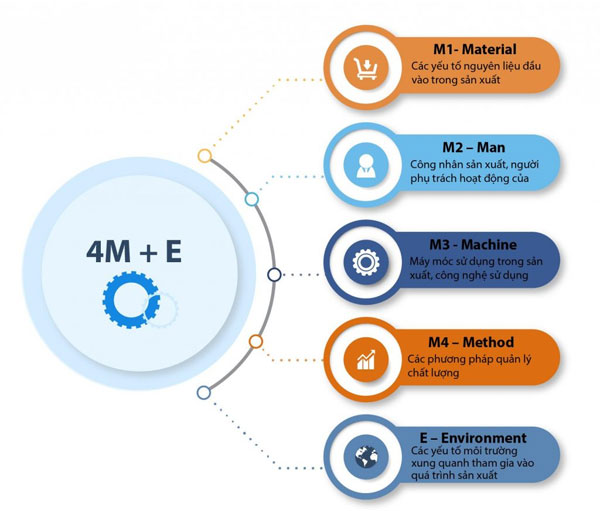
The 4M+E model
M1 – Material: input materials for production.
M2 – Man: workers and the people in charge of operating machinery.
M3 – Machine: equipment and machinery used in production, and the technology used.
M4 – Method: quality management methods.
E – Environment: the external environment involved in production, such as temperature and humidity...
Which management software should you choose?
Depending on its business model and the nature of its products, a business can choose effective production management software as follows:
- If finished goods quality depends most on Material (raw materials, supplies), the business should use ERP resource management software - specifically the purchase/sales and inventory management modules to trace purchasing information, including purchase date, receipt date, time in stock and the material's expiry date.

If finished goods quality depends most on Material, the business should use ERP software
- If finished goods quality is driven most by Man (people), managers need specialized HR management software. Its key features include:
Tracking information on employees in the business.
Managing staff competencies and work results.
Training and recruiting staff.
Setting up reward and motivation policies.
Aggregating and analyzing trends in the factors that affect individuals and, as a consequence, product quality.
- When Machine (machinery, technology) plays the key role, the business needs software to manage this equipment. Through software that reads and connects information from PLCs, the business can easily monitor things such as:
The production process.
The quality of each product.
The condition of each machine.
Production time.
Coordinating the quantity of materials received.
A guide to implementing effective production management software
To implement production management software effectively, the business's operating system needs to do the following:
- Managers need to be committed and closely supervise the software rollout, always keeping track of how the organization is changing.
- The implementing party needs to communicate well so all staff correctly understand the software's benefits before using it.
- All data must be put into the system as early as possible so it can be analyzed and alerts raised immediately when problems occur.

Managers need to be committed and closely supervise the software rollout
- Businesses can get data from production equipment through the machine's HMI screen or PLC controller. However, not every device has the connections built in, so businesses may need to replace the HMI screen or upgrade the machine's PLC controller.
- Environmental parameters are very large data sets, so cloud storage should be chosen, though this can increase costs and reduce security.
- For materials management, the initial ERP rollout will be costly, but the long-term benefits will be much greater.
- The entire quality control process needs to be standardized with clear documentation, so managers can identify the data and factors that affect product quality.
- The process for using the production management software needs to be rigorous, clear and easy to understand so staff can easily get used to it and operate it effectively.
- The responsible department in the plant needs to communicate regularly with the software developer to make sure everything stays on track.
In short, effective production management with modern software helps businesses optimize costs and achieve excellent finished goods quality in an ideal time frame. Adopting today's technology is clearly the right choice for all businesses in general and traditional manufacturers in particular. Contact Sbiz.vn today for detailed advice on optimizing your business's production line!