1. The problem: the bigger the warehouse, the harder it is to control
Unclear stock locations: reliance on memory and paperwork; when one person is off, others have to search blindly.
- Manual label scanning: slow, error-prone PDA operations that depend on each employee's discipline.
- Inventory not in real time: the figures in the books are always out of step with what is actually on the shelves.
- Hard to trace lots/orders: every search for a specific lot wastes time.
2. Profile of a typical business
Before automation, this business faced exactly the problems above: it took 5–10 minutes on average to find and pick a pallet; book inventory accuracy was only about 90–93% compared with physical counts; and every month there were dozens of cases of pallets put in the wrong bin, temporarily lost or the wrong lot shipped. Management wanted a solution that could be rolled out in phases, with low risk, and without having to stop production to rebuild infrastructure.
3. The solution: three technologies combined on one forklift
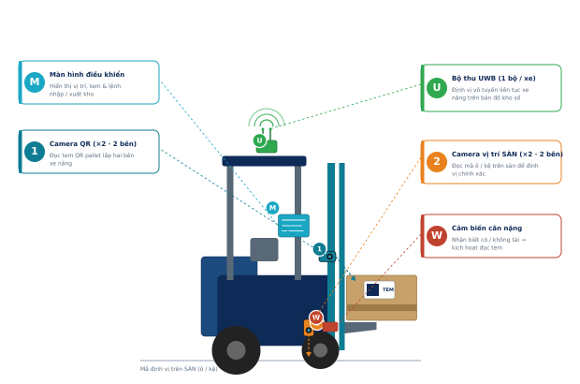
Each forklift is equipped with a control screen, AI cameras and a load sensor (the number of cameras depends on distances and locations in the warehouse), plus UWB positioning
3.1. AI cameras and IoT sensors — accurate reading right at the point of operation
• Two cameras read pallet QR codes: they identify the correct order, lot number and quantity as soon as the goods are lifted — returning accurate pallet information.
• Two cameras read location codes: they read the location codes on the floor/racks to identify the correct bin/rack when putting away and picking — returning the exact location. The AI cameras handle close-range accuracy: knowing for certain which pallet is being handled and which bin it belongs to.
• Load sensor: detects the moment the forklift lifts a pallet → triggers the AI cameras to read the label in detail.
• Control panel: shows the location, label and receipt/issue order right on the forklift, guiding the driver.
📌Learn more: Just 5 minutes – master smart, real-time warehouse management
3.2. The digital warehouse map (WMS) — the coordinating brain
The entire warehouse is modeled as a digital map. This is the “brain” that decides where goods should be stored. Instead of letting staff pick empty spots out of habit, the system calculates the optimal storage location from data: FIFO rules, the upcoming shipping plan, available bins and the specifics of each order. The suggested location is shown right on the forklift screen.
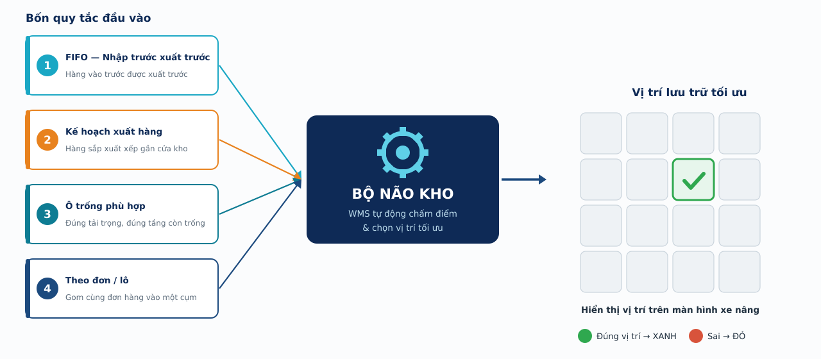
The digital warehouse map automatically calculates the optimal storage location
Core value: goods are arranged optimally for fast picking, space is used to the fullest, and nothing depends on any individual's memory anymore. The warehouse runs on rules, not habits.
3.3. UWB radio positioning — continuous tracking across the warehouse
UWB (Ultra-Wideband) is a positioning technology using ultra-wideband radio waves that works like an “indoor GPS”: highly accurate, stable, good at penetrating obstacles and independent of lighting. The mechanism is simple: each forklift carries a receiver (tag); transmitters (anchors) are mounted on columns and walls, on average one every ~30 m, with the number based on floor area to cover the whole warehouse. The anchors continuously determine the tag's position, so the system knows exactly where each forklift is on the digital map at all times.
The problem UWB solves:
AI cameras only “see” goods and locations at the exact moment they read a code. Between two reads — while the forklift is moving, when a code is obscured, when goods are on high racks or near a far wall — the system loses track of the forklift. That gap is exactly what UWB was made to fill.
Core role:
UWB answers the question cameras cannot answer continuously — “which forklift is where, right now?” It turns the cameras' separate code reads into a seamless, uninterrupted stream of location tracking.
So what does “continuous tracking” deliver?
• Goods are never lost between operations: the system always knows where the forklift (and the pallet on it) is heading, even before the camera reads the location code — no more “blind spots in time” between two scans.
• Covers the cameras' blind spots: on high racks, far walls and poorly lit areas — where long-range images are less reliable — UWB still locates reliably thanks to radio waves.
• Fully automatic recording: whenever the forklift's position changes, the warehouse software updates automatically; the driver does not have to press a button or perform any extra scan.
• Real-time inventory & map data: because locations are updated continuously, inventory and the goods map always reflect reality minute by minute, instead of waiting for end-of-shift consolidation.
• A foundation for optimization & automation: continuous movement history enables analysis of operational flows, travel distances and bottlenecks — and is a stepping stone toward coordinating AGVs/robots later.
In short: AI cameras provide accuracy at the point, while UWB provides continuity across the warehouse. Together they ensure location data is never “broken”, which is what keeps inventory accurate in real time.
Simulation demo - automated warehouse management system with AI cameras and a digital warehouse map

4. How an operating cycle works
What makes the difference is that all three technologies run simultaneously, in a closed loop, within a single operation by the driver:
1. The forklift moves. Its UWB receiver is continuously located by the anchors on the digital warehouse map.
2. The pallet label is read. The QR camera reads the label and identifies the goods: order, lot, quantity.
3. The floor location code is read. The location camera reads the bin/rack code at the moment of put-away or picking.
4. The WMS records. The system checks and records the location + inventory fully automatically.
5. Display & confirmation. The forklift screen shows green if the pallet is put in the right bin and red if not — corrected on the spot.
Result: forklift and goods locations are recorded automatically and continuously, without any label scanning or manual note-taking. Inventory data is always accurate in real time.
5. Why UWB is needed, not just AI cameras
This is an important cost question. AI cameras read very well at close range, but when they have to read codes on high racks or far walls, long-range images are less reliable and affected by lighting and obstructions. UWB fixes exactly that weakness with stable radio positioning that does not depend on distance. The table below compares the two options:
|
Criterion |
AI cameras + digital map only |
AI cameras + digital map + UWB |
|
Reading labels & bin/rack codes (close range) |
Good |
Good |
|
High racks / far walls |
Poor — long-range code reading is inaccurate and unstable |
Stable — radio positioning, independent of distance |
|
Positioning while the forklift moves |
Intermittent — only when a code is read |
Continuous, real time |
|
Affected by lighting / obstructions |
Cao |
Low (radio waves) |
|
Knows the forklift's location at all times |
No |
Có |
|
Investment cost |
Lower |
Higher (extra receivers/transmitters) |
6. Expected results once operations stabilize
With this design, a business of the size described in Section 2 can expect the following improvements (typical estimates, depending on the warehouse):
• Search & picking time cut by about 40–60% — from 5–10 minutes to 2–3 minutes per pallet, thanks to locations shown on screen.
• Inventory accuracy of 99%+ — up from ~90–93% before, since every change is recorded automatically in real time.
• 70–90% fewer wrong-bin put-aways/picks — thanks to green/red alerts at the moment of operation.
• Less dependence on people — new staff can operate by following on-screen instructions without having to “know the warehouse by heart”.
• Instant reports — managers know exactly where goods are and how many are left, at any time.
• Ready to scale — the digital warehouse map is the foundation for next-step automation such as AGVs/robots.
Weighed against the cost of staff searching for goods and losses from misplaced items and late deliveries, most projects of this size can expect a payback period of about 12–24 months — the exact figure depends on the number of forklifts, the floor area and each business's actual throughput.
7. Conditions for success and how to control risk
No technology solution is “plug and play”. The difference between a successful project and an unfinished one lies in preparing the conditions and anticipating the risks. The conditions you need:
• Clear floor location QR labels, firmly attached, not peeling, with an anti-abrasion protective layer; location codes applied correctly to each bin/rack.
• A clean, well-lit warehouse floor for reliable camera reading.
• Enough UWB anchors (~one per 30 m) on columns/walls for continuous coverage of the whole warehouse.
• Stable industrial network/Wi-Fi infrastructure and power for the on-vehicle devices and anchors.
• Permission to mount devices on forklifts (cameras, UWB receivers, screens).
• Coordinated, trained staff: IT together with warehouse keepers/team leaders.
Common risks and how to control them
• Floor location labels peeling, torn or faded → misreads. Control: use abrasion-resistant industrial labels with laminate coating, and inspect and replace them periodically.
• Poor camera reading due to dust, lighting or obstructions. Control: clean the cameras and light the reading zones; UWB compensates for positioning when the cameras struggle.
• Insufficient UWB coverage in large warehouses with many metal obstacles. Control: survey and install enough anchors, calibrate and increase density where needed.
• On-vehicle devices failing, vibrating or running out of battery. Control: choose vibration-resistant industrial devices, maintain them periodically and keep spares.
• Initial deployment not properly calibrated. Control: pilot 1–2 forklifts (PoC) and measure the acceptance criteria before scaling up.
Conclusion: start with one forklift
Warehouse automation does not have to start with a huge investment or a plant shutdown for renovation. By giving “digital senses” to the forklifts themselves — AI cameras for accurate reading, a digital warehouse map for smart coordination, and UWB for continuous positioning — businesses can eliminate manual work and master locations and inventory in real time, laying the foundation for the next steps of automation. Above all, a phased roadmap lets you start small, prove the results, and then scale up.
SmartBiz is ready to work with each business to shape the right roadmap, based on its business goals, operational maturity and desired pace of expansion.
|
Start your warehouse automation journey with SmartBiz • Free assessment of your current warehouse • Request a consultation on an industry-specific solution • Watch a demo of the solution in real operation |