Welcome to our special insights into purchasing management and how Trung Nguyen Coffee successfully manages its supply chain - where smart, modern purchasing and supply systems have created the very best experience for customers.
We are happy to share the secrets of improving purchasing management efficiency. You will discover the unique purchasing management process Trung Nguyen uses to maintain a stable supply, control quality and optimize its supply processes.
If you are interested in the secrets of successful purchasing management and love Vietnamese coffee, join us to explore how purchasing and the supply chain are managed, for deep insights.
What is purchasing management?
Purchasing management (or supply management) is an important part of a business's supply chain management. It covers managing and controlling the activities involved in procuring and receiving goods from domestic and international sources. The goal of purchasing management is to ensure the business has a stable supply of good quality at competitive prices.
Purchasing management activities include selecting suppliers, negotiating prices and terms, tracking and evaluating supplier performance, managing inventory and ensuring the purchasing process is carried out efficiently. Purchasing management also involves reducing supply chain risks, securing supply and maintaining positive relationships with supply partners.
A unique purchasing management method from smart purchasing management software
The purchasing management process
The purchasing management process is a set of activities designed to control and optimize a business's procurement. In today's business environment, this process not only saves costs but also contributes to flexibility and proactiveness in supply chain management, laying the foundation for the business's success and sustainability.
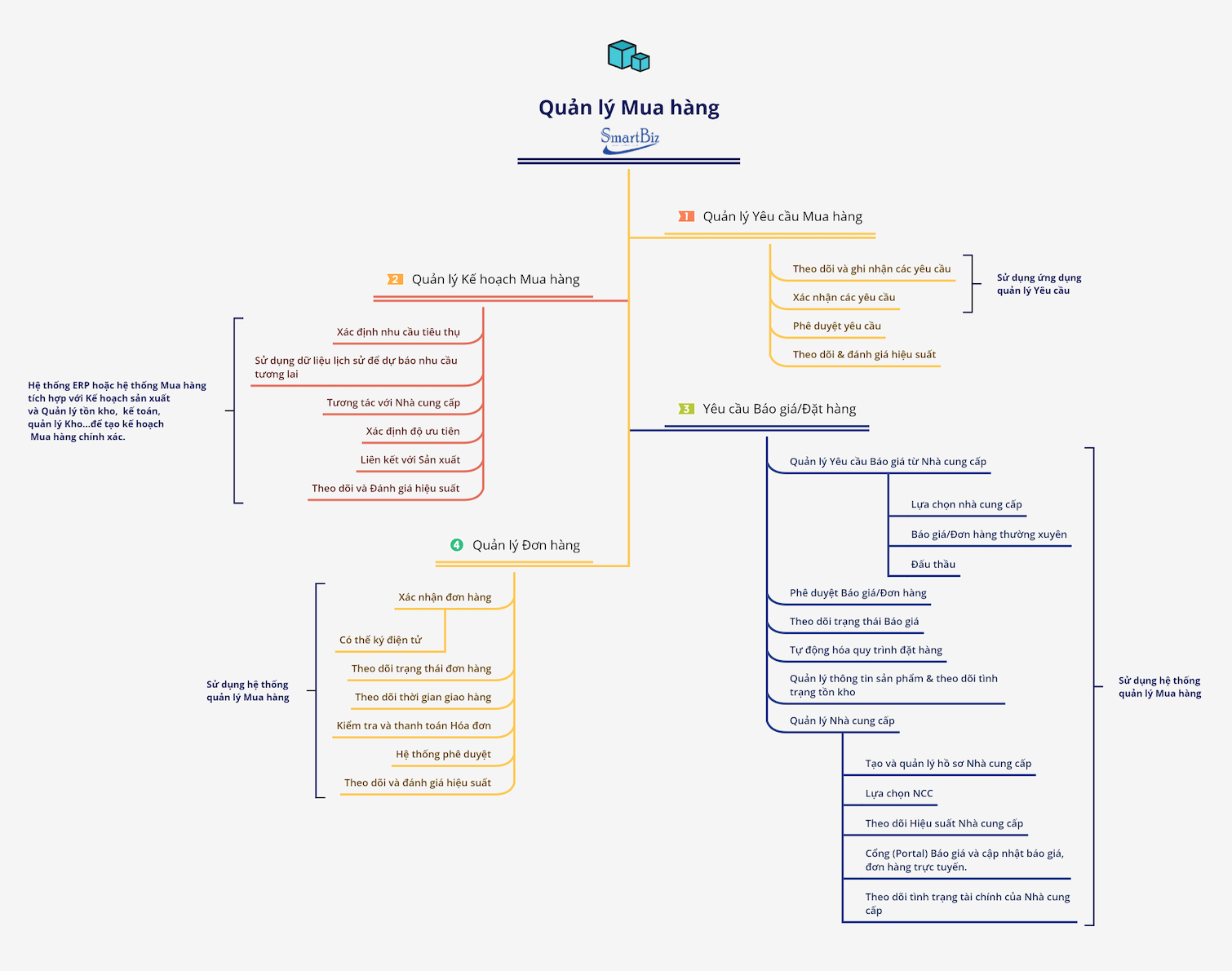 An effective purchasing management process
1. Managing purchase requests
Managing purchase requests is an important part of procurement in an organization. Here are some effective methods for managing purchase requests:
Purchase management system
An automated purchase management system automates the purchase request process. It can integrate with other systems such as production planning and inventory management to provide accurate forecasts of purchasing needs.
Request confirmation
Set up a purchase request confirmation process to make sure every request is reviewed and approved before moving on to the next steps. Classifying requests helps prioritize and handle them efficiently.
Set authority limits
For large organizations, setting authority limits for creating purchase requests can reduce the risk of abuse and ensure the process is controlled effectively.
Track and evaluate performance
Set up a tracking system to evaluate the performance of the purchase request process. Feedback from requesters and suppliers can help improve the process continuously.
2. Managing the purchase plan
Here are some effective methods for managing the purchase plan:
Use an ERP management system
An ERP system integrates information from departments such as Production, Accounting and Inventory to create an accurate purchase plan. Figures from these departments can feed into the purchasing demand forecast.

Khám phá Video: 📌 How to plan purchasing & inventory accurately – avoiding the mistakes 90% of businesses make
Determine consumption needs
Assess and determine consumption needs based on the production schedule and expected production capacity. Understanding these needs clearly helps build an accurate purchase plan.
Optimize flexibility
Build the purchase plan with flexibility to cope with fluctuations in demand or changes in the production process. This minimizes shortages or excess inventory.
Use historical data
Analyze historical purchasing and consumption data to forecast future demand. This improves the accuracy of the purchase plan.
Work with suppliers
Work closely with suppliers to stay updated on stock levels, delivery times and factors affecting procurement.
Set priorities
Set the priority of the items to be purchased so the most important ones get high priority in the purchase plan.
Link with the production plan
Tie the purchase plan closely to the production plan so material needs and the production process stay in sync.
Track and evaluate performance
Set up a system to track and evaluate the performance of the purchase plan. Performance indicators provide important information for improving the process.
Negotiate with suppliers
Negotiate with suppliers on prices, delivery terms and other conditions to make sure the purchase plan is sound and efficient.
3. Supplier management
Here are some effective methods for supplier management:
Create and manage supplier records
Purchase management software lets you create and manage detailed records for each supplier, including name, address, contact details, product list, transaction history and other important information.
Define supplier selection criteria
Define key criteria such as product quality, reliability, price and delivery time. This helps purchasing managers choose suppliers that fit the organization's needs.
Track supplier performance
The system can track each supplier's performance based on factors such as quality, delivery time and contract compliance. This gives the organization a complete view of its business partners.
Track suppliers' financial health
The software can track the financial health of key suppliers. This information indicates their financial capacity and the level of risk in working with them.
Automate the ordering process
The purchase management system can automate the ordering process, from creating purchase orders to notifications and confirmations. This reduces errors and makes the process more efficient.
Manage contracts and terms
The purchase management system tracks contracts and terms with suppliers. Expiry dates, payment terms and other factors are managed automatically to ensure compliance.
Online quotation portal
Suppliers can update quotations online through a web interface or mobile app. The portal lets them conveniently enter details on products, prices and other conditions.
Goods status updates
Suppliers can update the status of goods online, including stock information, expected delivery times and any product changes. This lets buyers and managers follow the information continuously.
Online purchase order confirmation
Suppliers can confirm purchase orders online through the portal. This reduces the time and error risk of passing information by email or on paper.
Notifications and updates
The portal usually has a notification feature so suppliers are informed of important events such as new purchase orders, requests for quotation or order changes. This improves timeliness and enables a fast response.
4. Managing requests for quotation/orders
Here are some effective methods for managing requests for quotation/orders:
Use a purchase management system
Use a purchase management system to create, track and manage requests for quotation/orders. The system can send notifications and track the progress of each step automatically.
Approve requests
Set up an approval process for quotations/orders to make sure every order request is reviewed. This process also helps control the budget and the quality of products/services.
Define and manage approvers
Define the approver for each type of order request. This ensures the approval process is fast and efficient.
Track and report status
Use the system to track the status of each order request and create summary reports on their status. This gives managers an overview of the process's performance.
Manage product information
Keep detailed product information in the system, including descriptions, prices, specifications and supplier information. This makes it easy to choose products when creating order requests.
Negotiate with suppliers
Before creating an order request, negotiate with suppliers on prices, payment terms and other conditions. This ensures the terms have been discussed and accepted before the purchase order is created.
Track stock levels
Track current stock levels to make sure order requests reflect real needs and avoid excess inventory.
5. Purchase order management
Here are some effective methods for managing purchase orders:
Assign purchase order (PO) tracking numbers
Each purchase order is assigned a tracking number so it can be tracked easily and identified quickly during processing and follow-up.
Confirm purchase orders
Before sending, make sure each purchase order is confirmed and double-checked so all information is accurate and complete.
Track delivery times
Make sure purchase orders are tracked against the delivery times committed by the supplier. If there is a delay, it must be reported and handled promptly.
Track purchase order status
Use the management system to track the status of purchase orders. This ensures every party involved can follow the procurement process effectively.
Confirm receipt
When goods arrive, the receiving team needs to confirm that the products and quantities are correct. If there are inconsistencies, the supplier and the purchasing department must be notified so they can be dealt with.
Check and pay invoices
Check supplier invoices and compare them with the information in the purchase order. Confirm that all delivery and price conditions have been met before paying.
Create an approval system
Build an approval process so each purchase order goes through internal controls before being accepted and sent to the supplier.
Track and evaluate performance
Set up a system to track the performance of the ordering process for a complete view of how it works and opportunities for continuous improvement.
How Trung Nguyen Coffee succeeds at supply chain management
1. About Trung Nguyen Coffee
On 16 June 1996, Chairman Dang Le Nguyen Vu founded Trung Nguyen in Buon Ma Thuot – Vietnam's coffee capital – with a rickety bicycle as his starting capital, together with the faith and fierce determination of youth and the ambition to build a famous coffee brand and spread the taste of Vietnamese coffee around the world.

Trung Nguyen Coffee Group (source: Trung Nguyen Coffee)
Trung Nguyen Coffee is not just a young Vietnamese coffee brand; it quickly built its reputation and became a familiar symbol for consumers at home and abroad. In just 10 years, from a small coffee company in the coffee capital of Buon Ma Thuot, Trung Nguyen grew into a strong group with six member companies, including Trung Nguyen JSC, Trung Nguyen Instant Coffee JSC, Trung Nguyen Coffee Co., Ltd., G7 Trading and Services JSC and the Vietnam Global Gateway (VGG) joint venture, operating mainly in the production, processing and trading of tea and coffee, brand franchising, and modern distribution and retail services.
Trung Nguyen pioneered the franchise business model in Vietnam. It has now built a network of nearly 1,000 franchised coffee shops nationwide and 8 shops abroad in countries such as the US, Japan, Singapore, Thailand, China, Cambodia, Poland and Ukraine. Trung Nguyen coffee and G7 instant coffee are exported to 43 countries, with a strong presence in key markets such as the US and China. Trung Nguyen has also built a network of more than 1,000 G7Mart convenience stores and distribution centers nationwide.
2. Trung Nguyen's success in supply chain management
Trung Nguyen in its relationships with suppliers. Trung Nguyen's supply chain is considered a successful one, from proactive sourcing of raw materials and investing in and controlling production efficiently to distribution that reaches far and wide right to the consumer.
Trung Nguyen and its suppliers
Today, Trung Nguyen has an extremely efficient production system with less competition, as its raw materials all come from coffee farms that Trung Nguyen itself invests in and manages.
Supplier training policy
Trung Nguyen has run technical training courses for farmers; specifically, the company recently held the 3rd training session in its program to expand 1,000 ha of sustainable coffee (UTZ Certified) for 550 farming households in Ea Tul commune (Cu M'Gar district – Dak Lak). This is one of Trung Nguyen's strategic activities to improve the quality of its raw materials to create
Technical support policy for input investment.
As part of its sustainable coffee growing area development program, Trung Nguyen advises and supports farmers in applying modern Israeli drip irrigation together with Yara fertilizer technology, saving costs, delivering high efficiency and protecting the environment. The program delivered strong results over the past year and won the support of coffee-growing households.
Strengthening relationships with suppliers.
Trung Nguyen's CEO makes regular trips to visit its suppliers to strengthen friendly, long-lasting relationships.
Trung Nguyen invests in a network of factories.
Along with developing sustainable UTZ Certified raw material sources, Trung Nguyen has expanded its investment in coffee processing factories with the world's most modern technology to create special coffee products that meet domestic and international market demand.
Mr. Dang Le Nguyen Vu, CEO of Trung Nguyen, said the factory's entire equipment line and technology were manufactured and transferred directly by FEA s.r.l, a leading Italian manufacturer of food processing and instant coffee equipment. “Investing in factories with modern technology is the foundation for Trung Nguyen to integrate and compete with other coffee brands in the region and worldwide.
Trung Nguyen and its distributors.
Trung Nguyen has made consistent reforms. A series of newly designed shops in the Trung Nguyen franchise chain embody creativity, culture and art, such as creative space clubs, Saturday Coffee, youth creative clubs and book cafés, helping bring a new, more professional image to the Trung Nguyen franchise chain.
Inspecting and controlling distributors' activities: Trung Nguyen regularly reviews and evaluates distribution effectiveness through sales. Distributors that perform poorly over a long period receive reminders or have their contracts terminated. This is a friendly and necessary measure for the company to achieve its distribution goals.

Trung Nguyen's coffee shop network (source: Trung Nguyen Coffee)
Customer relationships in Trung Nguyen's supply chain.
Trung Nguyen's customers are mainly individual consumers who buy at retail outlets or enjoy coffee in Trung Nguyen's shop chain. In Trung Nguyen's premium shops, besides roasted beans, customers can also buy hand coffee grinders so that they can grind just enough beans for one phin filter and enjoy the full experience like a real barista. Trung Nguyen has also built a coffee village in Dak Lak where tourists can visit and enjoy coffee in a space very close to nature. This is a fairly unique model Trung Nguyen has built to create a fresh image in its customers' minds.
Trung Nguyen always looks for every way to serve its customers as well as possible. In addition, institutional customers buying in large quantities receive the company's discounted prices and other benefits for long-term customers.
3. Trung Nguyen's purchasing process
Defining needs and setting coffee bean standards
In Vietnam, about 80% of people drink coffee as part of daily life, and the share of people with a deep passion for coffee is far from small. Vietnamese coffee culture is also very rich, and everyone's coffee habits are different. Competition in the coffee industry is extremely fierce: the country has 97 green coffee processing facilities, 160 roasted and ground coffee facilities, 8 instant coffee facilities and 11 blended coffee facilities. To gain a competitive edge and grow sustainably, coffee businesses must choose and create distinctive features for their brands. So, to survive for the long term, Trung Nguyen has set standards for coffee beans to deliver the best, most distinctive products to its customers.
Finding suppliers and buying coffee beans
For a business, suppliers play a very important role: they provide the input materials for production, which affects the quality and price of the output products. For Trung Nguyen, coffee beans are the main raw material.
Trung Nguyen selects coffee from 4 regions: Robusta beans from Buon Ma Thuot, Arabica beans from Jamaica, and Ethiopian-type coffee from Brazil. Trung Nguyen has 2 ways of buying: through private businesses and traders, and directly from farmers. Today many private businesses and traders face difficulties and default on their debts, directly affecting supply, which falls short in both quantity and quality, so Trung Nguyen limits its use of these suppliers.
The company has also found a new way to solve its raw material supply problem: investing in and directly managing farmers' coffee farms itself, turning them into part of the business. This gives the company more control over its raw materials and strengthens the relationship between the company and coffee farmers. Besides coffee, Trung Nguyen also has other suppliers, such as packaging suppliers and machinery and equipment suppliers…
Negotiating and signing purchase contracts
Once suitable suppliers have been found, the two parties negotiate and sign a contract. Issues to negotiate with suppliers include the technical standards of the goods, specifications, packaging, quality, prices and price fluctuations, inspection, grading and handling of substandard goods…
Tracking and receiving goods into the warehouse
After signing the purchase contract, the business needs to monitor and track the delivery process to know the status of the goods, the delivery time and the receipt time, so that coffee production and the company's profits are not affected.
Evaluating suppliers
After buying and receiving the coffee beans into the warehouse, it is very important to review the supplier's performance together with the people who made the purchasing decision. The evaluation lets Trung Nguyen know whether the supplier has met its commitments on the goods, such as whether the quality met the standard and how the service was... Timely evaluation helps the business detect mistakes and deal with them as quickly as possible to avoid unwanted losses.
4. Challenges in Trung Nguyen's purchasing management
Although Trung Nguyen Coffee only appeared around 1996, it has built a strong reputation and become the most familiar coffee brand for consumers at home and abroad. Trung Nguyen has risen to become a powerful group with 6 member companies, so its experience and diligence at every stage are undeniable. However, the business cannot avoid the difficulties the market and the environment bring.
- The biggest difficulty businesses face in purchasing management is the lack of alignment between the needs of different departments and staff's “rough estimates”, with no control over when to buy and what to buy. For a large group in particular, consolidating, evaluating and approving purchasing needs from its branches takes a lot of time and money, and negative practices can't be controlled: contractors using “back doors”, individuals seeking personal gain... which reduce product quality.
- Coffee is a very climate-sensitive crop with demanding requirements for geography, climate, water sources and more in order to grow well. But today a serious problem is rising temperatures, which reduce coffee quality as the fruit ripens faster. Because climate change reduces quality, it is hard to guarantee enough coffee beans of sufficient quantity and quality for production. In the future, this could lead to serious coffee bean price increases, making buying coffee beans more difficult.
Conclusion
By exploring the secrets of purchasing management and how Trung Nguyen Coffee has succeeded in supply chain management, we have not only seen an effective business model but also gained a deep understanding of the importance of purchasing management and effective supply chain management.
Given the biggest challenge Trung Nguyen faces, it should build a rigorous process to evaluate and approve purchasing needs from its different branches. Integrating a smart purchase management system to build a purchase forecasting and planning system and automate the purchasing process would help forecast purchasing needs better, improving the accuracy of inventory management, reducing the risk of shortages or surpluses and cutting unnecessary costs from inefficient purchasing.