
Popular inventory valuation methods today
Inventory valuation methods are among the most basic things every accountant or accounting department in a business must understand. These methods play an especially important role in running a production management system, so the article below gives you the most complete information on inventory valuation methods.

What are inventory valuation methods?
What is inventory?
Inventory is the products a business holds to sell eventually. Put another way, inventory is the stock a company produces to sell or the components that make up its products. Inventory is therefore the link between producing and selling products, and it is also a short-term asset that plays an important role in the business's production and operations.

Inventory is the products a business holds to sell eventually
Principles of inventory accounting
The principles of inventory accounting are clearly set out in Article 23 of Circular 200/2014/TT-BTC on inventory accounting principles. You can look up this Circular with a search engine to learn the specific principles.
Popular inventory valuation methods today
The inventory valuation methods below are the most widely and frequently used.
The specific identification method
Specific identification is an inventory valuation method based on the actual value of each item purchased and each product manufactured, so it only suits businesses with few, stable, identifiable items. Under this method, products, goods and materials issued from a given received lot are valued at that lot's receipt unit price.
The weighted average method
Under this method, the value of each type of inventory is calculated from the average value of that type of inventory at the start of the period and the value of that type purchased or produced during the period. The average can be calculated per period or after each lot received, depending on each business's circumstances.
The first in, first out (FIFO) method
This inventory valuation method is based on the assumption that inventory purchased or produced first is issued first, and the inventory remaining at the end of the period is the inventory purchased or produced near the end of the period.
Under this method, the value of goods issued is calculated at the price of lots received at or near the start of the period, and the value of ending inventory is calculated at the price of goods received at or near the end of the period that remain in stock. This method is usually applied when prices are stable or tending to fall.
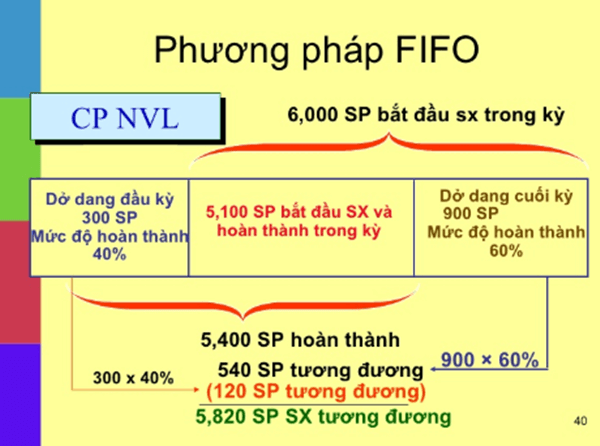
Inventory formula
The 4th inventory valuation method: last in, first out
The last in, first out method is abbreviated LIFO. Last in, first out (LIFO) is an inventory valuation method that records the most recently produced items as being sold or issued first. Companies using LIFO inventory valuation are usually those with relatively large inventories, such as retailers or car dealers, who can take advantage of lower taxes when cash flows and prices rise.
Inventory accounting methods
Here are the two most basic inventory valuation methods that every business can consider applying to its business and production.

Two of the inventory accounting methods
The perpetual inventory method
Businesses that use large amounts of materials usually choose the perpetual inventory valuation method. With this method, accountants must regularly and systematically track and evaluate the receipt, issue and holding of materials and goods.
This work reflects the state of goods in the warehouse, such as current quantities and how stock is increasing or decreasing. The business can then make timely decisions to adjust quantities or take appropriate corrective measures.

The perpetual inventory method helps businesses make timely decisions
The periodic inventory method
The periodic inventory valuation method is a way of valuing inventory in financial statements in which inventory is counted and declared at set intervals. The periodic method has the following limitations.
● The periodic inventory valuation method isn't timely, which limits work processing.
● The periodic method cannot provide accurate cost of goods sold figures between count periods.
● While the perpetual method lets you track individual inventory items so you can act promptly if stock is defective, the periodic system doesn't offer that flexibility.
● The periodic inventory valuation method is manual, more prone to staff errors, and data can be misplaced or lost.

The periodic method suits small businesses
Above is some essential information on inventory valuation methods that you may need in your business and production. Today there are many smart warehouse management software products that support these calculations, which sbiz.vn provides. If you need to update your software to build a more optimal management system, contact sbiz.vn.