
What is RFID technology? Applications of RFID in warehouse management
When we buy a barcode scanner, suppliers often tell us whether it can read RFID or print RFID. So what is RFID? How does this technology work, and what are its applications? Let's explore with sbiz.vn in the article below!
RFID là gì?
What is RFID technology? It is a technology that uses electromagnetic fields to automatically identify and track tags attached to objects. In other words, RFID is a remote radio-wave identification technique that allows data on a chip to be read over radio waves within a suitable distance.
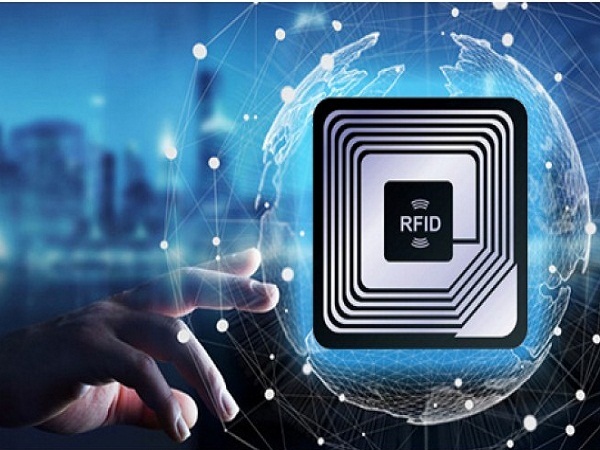
RFID is a technology that can be used to read information
The most outstanding feature of this technology is that RFID doesn't use a light beam like barcodes but works on a “contactless” principle.
What devices make up an RFID system?
An RFID system usually has 2 main components: tags and a reader that reads the information on the chip. Specifically:
● RFID tags can replace barcodes printed on products. Instead of having to hold a device close to a barcode to scan it, RFID tags let product information be read without direct contact.
● RFID readers are devices that read information from tags and can be fixed or mobile depending on the type.
How RFID works
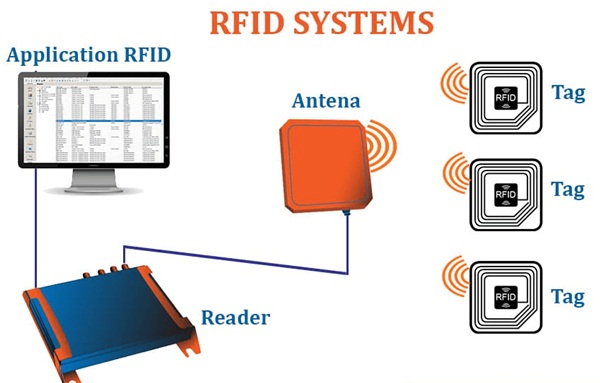
How RFID works
So how do RFID tags work? In fact, the principle of this technology is quite simple. When the reader sends out a radio signal, an RFID tag within range receives it and is powered. The tag then starts sending a radio signal back to the RFID reader, which interprets the changes and outputs the decoded information for the product.
Standard RFID read ranges and frequency bands
The reader's read range depends on a number of conditions and specific parameters, depending on whether the tag is active or passive. In general, RFID tags have a read range of < 3 feet, depending on the reader's specific frequency band. RFID systems using the UHF band have longer read ranges, depending on the specific application.
Some of the most popular and widely used RFID frequencies today are:
|
Frequency |
Name |
|
120 - 125 (kHz) |
Low frequency |
|
13.56 (MHz) |
High frequency |
|
868 - 928 (MHz) |
Ultra high frequency |
|
2.45 - 5.8 (GHz) |
Microwave |
The pros and cons of RFID in manufacturing
Here are the pros and cons of using RFID in manufacturing; you can use this assessment to decide whether to choose this technology for your business:
Pros
● No line of sight needs to be established.
● Tag data can easily be modified and rewritten when needed.
● Streamlines tracking of assets and goods in production.
● Gives the supply chain clearer visibility.
● Easy control of stock quantities.
● Saves costs and labor time in production.
Cons
● RFID costs more than barcodes.
● Its operating process is more complex than that of barcode applications.
● Data needs to be managed specifically; otherwise you can easily be flooded with useless information.
Applications of RFID technology in manufacturing and warehouse management
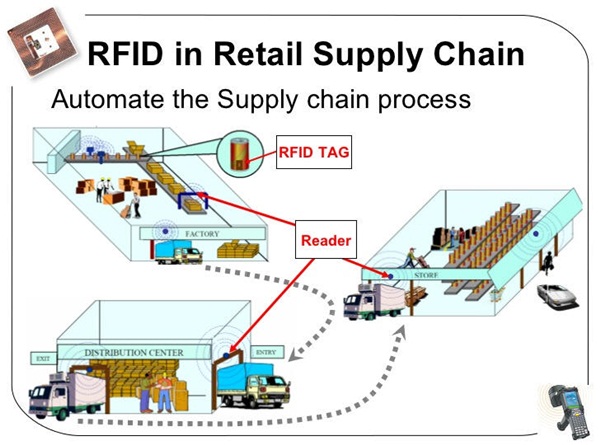
Applications of RFID in warehouse management
Many tasks that people used to do have been reduced and replaced by RFID technology. The technology can deliver the following benefits:
● In warehouse management: RFID systems are used to classify materials or products in the warehouse by attaching RFID tags to each item and using RFID readers. Actual warehouse data such as quantity, location and product classification is collected through the RFID system, stored and displayed on the warehouse server for management. As a result, receiving and issuing are controlled faster and more efficiently.
● In manufacturing: RFID systems are used instead of Kanban cards to optimize production lines, identify which stage semi-finished goods are at and control lead times as well as possible. This control helps you limit errors and prevent semi-finished goods from piling up on the production line.
Above is SmartBiz's explanation of what RFID is. But there's more: a set of features for managing warehouse operations, automated barcode-based warehouse management, automatic replenishment, lot traceability and stock counts. Optional synchronized integration with a smart MES manufacturing execution system, Purchase, Sales and Accounting helps eliminate all excess costs, streamline the supply chain and increase the business's cash flow. Would you like this? Find out now: The SmartBiz smart warehouse management solution
Before you leave the page, let us know your thoughts or whether this content was useful to you in the comments below.