Ordering the right amount of inventory can feel overwhelming. Ordering too much can really cost you, while not having enough loses you money and customers. This brings us to the idea of inventory management models. They are quite important for any business that handles inventory.
A brief introduction to Vinamilk
Vinamilk is proud to be a National Brand, among the “Top 10 most valuable dairy brands in the world” and the “Top 36 largest dairy companies in the world by revenue”. Vinamilk is present in nearly 60 countries and territories and is the only Southeast Asian representative in the Top 50 largest dairy companies in the world.
On 20 August 1976, Vinamilk was established by taking over 3 dairy plants left by the old regime: Thong Nhat Dairy (formerly the Foremost plant); Truong Tho Dairy (formerly the Cosuvina plant); Dielac Powdered Milk plant (formerly Nestle's powdered milk plant) (Switzerland).
Celebrating its 45th anniversary in 2021, Vinamilk has not only become Vietnam's leading nutrition company but has also established a firm position as a National Brand on the global dairy map.
Products for people
Always pioneering advanced nutrition trends worldwide to support the physical and intellectual development of generations of Vietnamese people, Vinamilk now has more than 250 diversified products serving consumers' needs.
Advanced governance
Vinamilk believes that an effective management process is the foundation for growth, bringing financial strength, investor confidence and efficiency to business operations.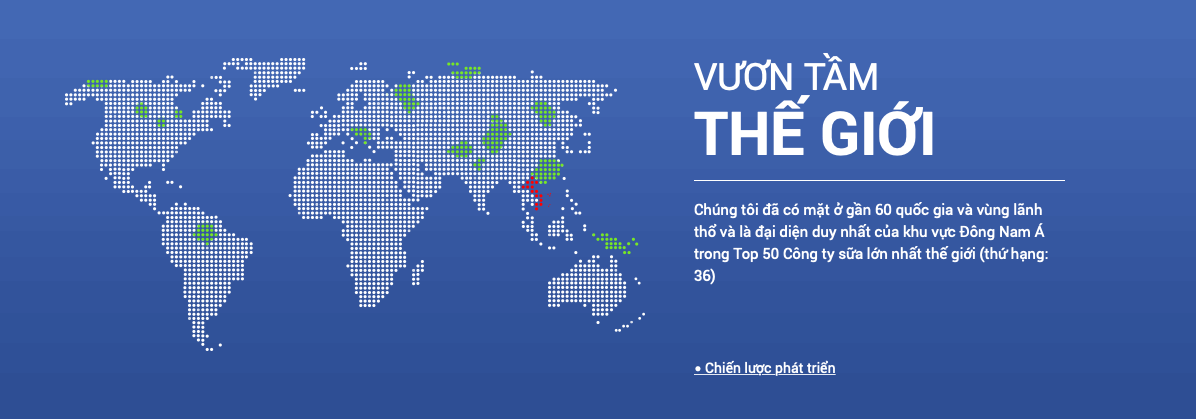
Photo: Vinamilk
The most popular warehouse management models today
What is an inventory management model?
Inventory management is a systematic approach to sourcing, storing and selling inventory, including both raw materials and finished goods (products).
In business terms, inventory management means providing the right stock, at the right level, in the right place, at the right time and at the right cost and price. Stock can be kept “in house” or nearby for ready use, or it can be kept in a remote store or distribution point for later use.
The importance of inventory management models lies in the accuracy they bring. You can clearly find out which items are selling and which aren't, what you need to have on hand and in what quantities. In addition, once you know these subtleties, you can reduce operating costs, lower carrying costs and free up cash for your business.
Popular inventory management models today
Every business should strive to continuously optimize its inventory levels and keep a healthy supply chain running at full capacity.
They are standardized ways to keep the right number of items in stock and keep parts and products flowing smoothly in and out of the warehouse at the right time.
Most inventory models need to answer the following questions:
How much should I order?
Where can I cut costs?
Which inventory sells fast?
How much ‘dead stock’ am I carrying?
Which inventory is increasing my holding costs?
Here are the 4 most popular inventory management models:
1. The Economic Order Quantity (EOQ) model
2. The Work in Progress (WIP) model
3. The perpetual inventory model
4. The Just-in-Time (JIT) inventory model
Learn more: Inventory management models and lean inventory tips
Each inventory model takes a different approach to help you know how much inventory you should hold. Which one you use depends on the type of materials, finished goods and merchandise your business has
Watch the video now: Demo of the new-generation smart warehouse management system! Integrated OCR, AI, IoT, QR codes and RFID to boost performance, optimization & accuracy
Vinamilk's optimal warehouse management model
Vinamilk's dairy plant runs on an automated, closed-loop line, from raw material input to product output.
Vinamilk has built a leading smart warehouse in Vietnam, covering 6,000 m2 with 20 in/out lanes, 105 meters long and 35 meters high, with 17 rack levels holding 27,168 pallet positions. Receiving and issuing are automated, with 15 RGVs (rail-guided vehicles) carrying finished-goods pallets into the warehouse and 8 stacker cranes placing the pallets into the racking.
Materials warehouse management operations
Vinamilk's inventory management involves two procedures: receiving materials and moving them internally, and issuing finished goods. Each procedure involves the cooperation of several departments.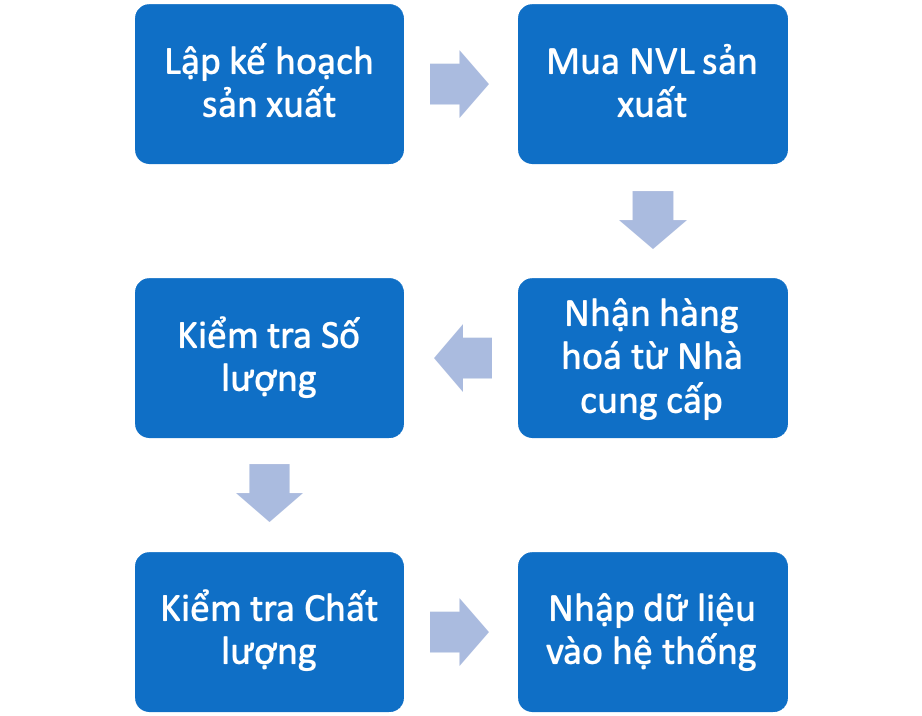
Vinamilk's warehouse management operations
Production planning
The production planning department and the board of directors draw up the production and business plan based on each year's goals and targets. The production planning department allocates targets to the plants based on the annual production plan. Production planning fits the available production variables, is maintained regularly and promptly, and adapts immediately to market fluctuations such as supply, demand, economic conditions, prices, etc.
Purchasing production materials
The purchasing department is in charge of planning material purchases. It uses the customer orders received by the sales department and sent to warehouse statistics each day to determine which raw materials are below the final safety stock level. Based on the warehouse's capacity to receive stock and the priority of the items in stock: which products need to be brought in to support upcoming sales promotions, so as to build a materials inventory strategy?
Receiving goods from suppliers
The materials receiving plan is then sent to the dispatch department (specifically materials dispatch) so it can dispatch Vinamilk trucks to collect the goods or schedule times so suppliers' delivery vehicles can arrive without causing congestion.
Checking quantity and quality
When products arrive at the plant from suppliers, the security department verifies the initial quantity. The incoming materials are then inspected by the quality control department to ensure they meet the pre-established criteria.
Entering data into the warehouse management system
Once the criteria are met, the items are received into the warehouse, where the storekeeper and warehouse staff check the quantities and put each type of material in its designated location. At the same time, the materials inventory data is entered into the computer system to trigger information verification.
Learn more: A guide to warehouse management processes that eliminate 95% of waste for businesses
The inventory management model Vinamilk applies
The best e-commerce merchants and retail operators are driven by a prudent reason to avoid stockouts. Using defined inventory management models - such as the Economic Order Quantity (EOQ) model - will help you work out the ideal order quantity to limit inventory costs (and stay away from the scariest part of e-commerce).
Of course, Vinamilk is no exception, applying the Economic Order Quantity model to calculate the optimal order quantity.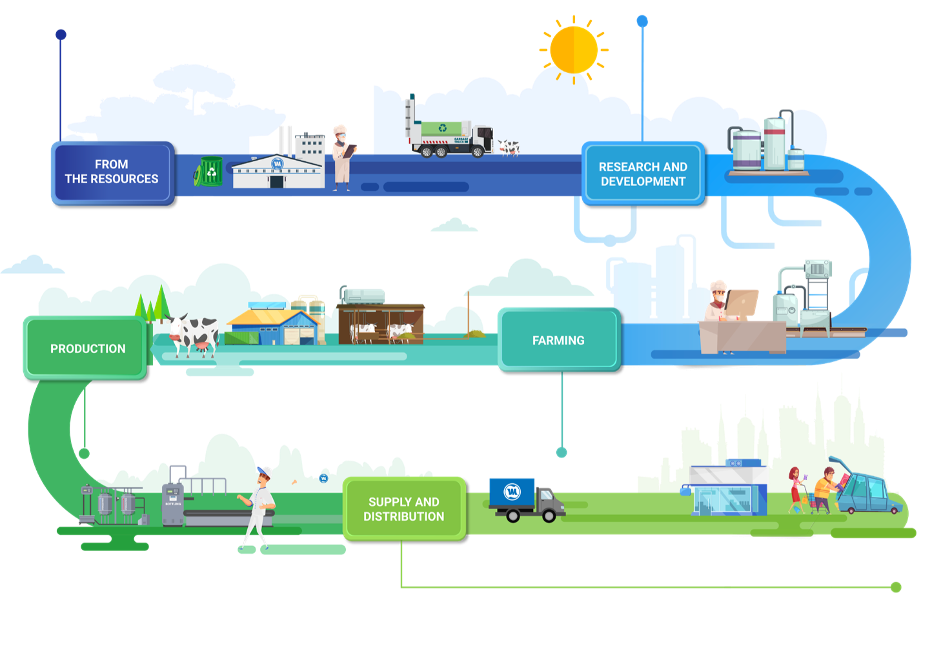
For materials inventory management, the company currently applies the EOQ ordering model. However, because each type of material has different characteristics, as do manufacturers' and suppliers' packaging, order cycles and lead times from order to delivery…, this optimal order quantity cannot fully follow the EOQ model and also draws on the experience of staff in the production planning department.
In some cases, the order quantity also depends on requests from shipping management when materials run short during production, as well as on the company's promotional programs.
For many years, Vinamilk's demand for raw fresh milk has grown rapidly. To meet this demand, the company has invested heavily in industrial-scale farms on the one hand and stepped up purchasing and developing raw fresh milk from households on the other.
How Vinamilk calculates the optimal inventory quantity
EOQ is a formula that a business should use to limit costs and increase confidence when reordering.
The assumptions of the EOQ model are as follows:
Inventory demand is stable (does not change).
The lead time from ordering to receiving goods is known and does not change.
The company receives all orders from suppliers at once.
There are only 2 types of cost: ordering cost and holding cost.
No shortages occur if orders are fulfilled on time; that is, if orders are placed after the optimal inventory level is determined and are fulfilled on time, no shortages will occur. Inventory shortages lead to disruptions in production and consumption.
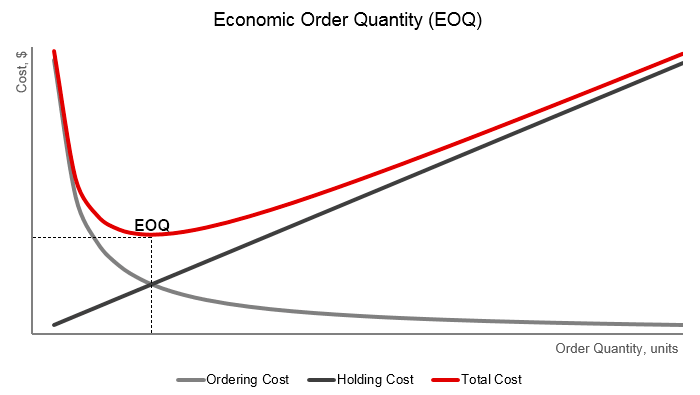
The EOQ model
D: Total quantity demand for 1 product each quarter
d: Total quantity demand for 1 product per day
P: Cost per order
EOQ: Economic order quantity
C: Holding cost per tonne of inventory
TCmin: Minimum total inventory cost
L: Lead time from ordering to receiving goods
n *: Optimal number of orders per year
T *: Optimal stocking interval
EOQ formula 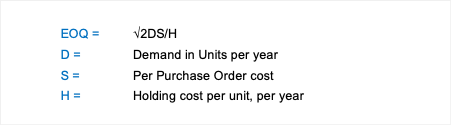
We assume the following data:
1. Product quantity demand:
(Unit: tonnes of milk)
| Indicator | 2021 | 2022 |
| Quantity of products required per year (D) | 346.750 | 365.000 |
2. Determine the product quantity demand per day (d), given that the company works 365 days a year
(Unit: tonnes of milk)
| Indicator | 2021 | 2022 |
| Quantity of products required per day (d) | 950 | 1.000 |
3. Determine the ordering cost for 1 order:
(Unit: VND)
| Item | Specific costs | 2021 | 2022 |
| Ordering cost per order (P) | - Telephone and correspondence costs - Transport costs - Receiving and goods inspection costs | 500.000 171.000.000 200.000.000 | 500.000 179.000.000 280.000.000 |
| Total | 371.500.000 | 459.500.000 |
4. Holding cost: storage cost per tonne of inventory
(Unit: VND)
| Chi phí | 2021 | 2022 |
| Holding cost (C) | 82.540 | 75.500 |
Tính EOQ, Tcmin, T, R và n
Based on C, P and D (assumed) calculated above, calculate the optimal inventory level (EOQ*), minimum total inventory cost (TCmin), optimal stocking interval (T*), the company's reorder point (R) and the optimal number of orders per year (n*).
Assume that the time from ordering to delivery (L) in both quarters is 7 working days.
| Indicator | Formula | 2021 | 2022 |
| 1. Optimal inventory quantity (EOQ*) | EOQ*= √((2×P×D)/C) | 55,869 (tonnes) | 66,655 (tonnes) |
| 2. Minimum total inventory cost (TCmin) | TCmin=(P*D)/(EOQ*)+(C×EOQ*)/2 | 4.611.422.073 (VND) | 5.032.429.085 (VND) |
| 3. Optimal stocking interval (T*) | T*=(EOQ*)/d | 60 (ngày) | 70 (ngày) |
4. Reorder point (R) | R= d x L | 6650 (sp) | 7000 (sp) |
| 5. Optimal number of orders per year (n*) | n*=D/(EOQ*) | 6 times | 5 times |
Warehouse management at Vinamilk's distributors and agents
The distributor network installs the Solomon system to inventory finished products; it automatically calculates the quantity of goods in stock. If it falls below the safety level, a purchase order is issued to service and customers. At the same time, supermarket chains have many sales supervisors and PGs, who also place orders based on the supermarket's daily sales by sending them to the customer service department.
· Coding, classifying, organizing and arranging inventory in the warehouse, and managing inventory in the ERP system. Vinamilk can handle inventory information simply with the ERP system, including inventory codes, inventory arrangement, receipt and issue information and product reports.
See also: Vinamilk's ERP system - a springboard for breakthrough
· Coding and classifying inventory: Vinamilk's materials and finished goods are quite diverse in standards, specifications, sizes... A convenient foundation for converting stock, recording, tracking and fast resolution.
When issuing goods, the company identifies them by symbols made up of letters and numbers. Vinamilk doesn't use chemical names for materials; instead it writes the substance's name to avoid codes that are hard to remember and errors in production caused by codes. Typically, labels are used for finished goods inventory, and product labels have 6 characters: the first two are the product group, the next two show the item code within each group, and the last two show the item code of each group of goods.
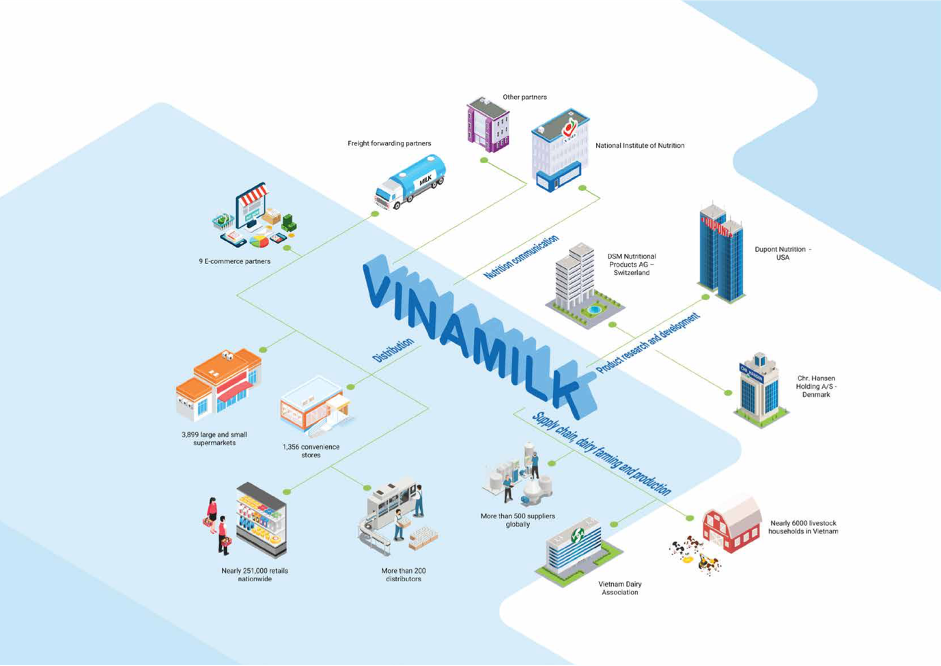
Vinamilk's partners, Photo: Vinamilk
How to arrange types of inventory
1. Materials
Raw fresh milk, imported powdered milk and flavorings are the main materials used at Vinamilk. Most of the remaining raw materials are stored in a cool environment at normal temperature, and the company follows the FIFO (First In, First Out) concept to ensure the quality of its supply.
With many types of materials, those received into the warehouse first are used in production first. Depending on the layout of the materials warehouse, materials are kept on huge racks 4-6 levels high. Heavy items are placed at the bottom, while lighter materials are placed on top.
The rack number, cell number, material name and code and these orders are stored in the warehouse management map system for each rack cell. So when looking for materials in stock or out of stock, we enter the product name or item code into the system, and it shows the location of that material, saving us a lot of time. Set up and remove excess parts.
2. Finished goods
Besides being classified by row and rack in review order like the materials warehouse, this finished goods warehouse is divided into 4 main storage zones: sterilized milk, yogurt..., and if inventory exceeds the warehouse's storage capacity and an external warehouse has to be rented, Vinamilk gives priority to its own warehouse for finished goods and the rented warehouse for materials.
3. How to manage inventory with the ERP model
In the ERP system there is a corresponding position showing how many lanes, how many products, how many racks and the order of the racks for each item code, along with its actual location in the warehouse.
An overall assessment of Vinamilk's warehouse management
Advantages
1. First, consider Vinamilk's inventory management activities. Inventory management efforts at Vinamilk are closely and flexibly coordinated between departments. The departments involved in inventory management - production planning, sales, customer service, purchasing, receiving and dispatch - work closely and harmoniously together in receiving, issuing and holding inventory, and show creative improvisation in the solutions they propose.
2. Second, Vinamilk's inventory management includes appropriate calculations. Vinamilk's inventory management usually adapts to changes in external variables such as each economic market and customer demand, and to internal factors such as the company's operating processes, capital, inventory situation, suppliers' supply capacity, delivery cycle system and the commercial characteristics of the goods.
3. Third, inventory management uses a flexible combination of the optimal EOQ ordering model and staff experience. To optimize cost and time, the EOQ model is used for materials inventory, modified for other influencing variables such as the business environment, ordering costs, etc. When it comes to finished goods inventory, there is some time to resolve situations where stock is insufficient to meet demand and partners' needs, establishing fairness among partners.
4. Fourth, materials inventory and finished items are coded, stored and transported efficiently. Storage, digitization and transport activities make it easier for Vinamilk to prepare goods for delivery to consumers while minimizing errors in goods checks. Furthermore, product storage and transport must follow the quality characteristics of the goods to ensure product quality when delivered to customers.
5. Finally, inventory management is carried out using ERP technology. Vinamilk's inventory management is very accurate and fast thanks to its ERP enterprise resource planning software. Furthermore, using an ERP system improves communication between plants, distribution centers and partners, giving an advantage in emergencies.
Disadvantages
For starters, Vinamilk's product classification has not yet been improved to achieve efficiency. In particular, the company only classifies items along the supply chain as raw materials, semi-finished goods and finished goods, rather than classifying raw materials, materials and finished goods by highest, medium or lowest share. As a result, allocating investment resources to inventory such as high-value products - for example, items held in huge quantities but with low profitability - will be inefficient.
Second, forecasting has not yet delivered optimal results. Forecasting is one of the most essential responsibilities of inventory management; if forecasts are inaccurate, they lead to a bad scenario. Too little inventory for sales and production, or too much inventory, will result in significant costs for the company.
Learn more: The essential guide to optimal inventory planning
Furthermore, although FIFO reduces the effect of inflation, leading to higher profits, it also leads to higher income tax for Vinamilk.
.
Conclusion
Great - you now have an overview of smart warehouse management operations, especially the inventory management model of one of the largest businesses in Vietnam.
What about your warehouse management system?
The SmartBiz smart warehouse management solution is ready to deliver a set of features for managing warehouse operations and automated barcode-based warehouse management. Track inventory across multiple locations, automatically manage reorder points, forecast demand and plan production and distribution. The system also includes features such as artificial intelligence (AI) and mobile device integration on the powerful ERP platform ranked 4th in the world. Learn more: Smart warehouse management solution
Before you leave the page, let us know in the comments whether this content was useful to you.