An essential step in the production process is getting material management right. Known by many names - assembly component list, product structure or product recipe - the bill of materials (BOM) is the foundation for the efficiency of many production and supply chain processes. The BOM plays a key role in material requirements planning, inventory, scheduling and product costing, making the entire production process robust and sophisticated.
With a BOM, you can optimize the production process by ensuring materials are suitable and available, avoiding shortages or waste. It helps build a tight production schedule and adjust the process to demand. The BOM also provides key information for calculating production costs and pricing products accurately.
To better understand how the BOM makes the whole process robust and sophisticated, this expert guide will help you apply tips and real-world examples to optimize production efficiency and save resources. Let's look at the following topics:
What is a bill of materials, or BOM?
A BOM is a structured, comprehensive list of the materials, parts and components needed to manufacture or repair a product, along with the quantities of materials needed and their names, descriptions and costs.
A BOM helps organizations plan material purchases, estimate costs, plan and control inventory, and minimize delays and waste in production.
An accurate, complete BOM helps identify the causes of product defects and quickly replace faulty parts, materials and components.
BOMs come in many forms and types. They can be single-level or multi-level. Some of the most common types are engineering, manufacturing and sales BOMs.
Why use a BOM?
A BOM enables efficient, accurate production. By identifying and costing all the materials and components needed to make a product before production starts, an organization can determine whether it has everything it needs to move forward with minimal risk of delay. This reduces the likelihood of both shortages and surpluses of materials or components. By helping ensure the right parts and materials are available at the right time and in the right quantities, BOMs help manufacturers stay on budget and on schedule.
Companies that work with contract manufacturers and give them a BOM can be more confident that the final product will meet their specifications.
Conversely, proceeding without a BOM increases the likelihood of costly, time-consuming mistakes. These include material shortages or surpluses, production downtime while materials are assembled, and extra expediting fees to make up for earlier delays.
The 2 BOM structures
A BOM can be structured in one of two ways:
Single-level bill of materials (BOM)
In a single-level BOM, each part that makes up the product or asset is listed once along with the required quantity. It is similar to a shopping list.
Although single-level BOMs are easy to create, they don't show the relationships between assemblies, subassemblies and the components used to build a product. If a product is defective, it can be hard to pinpoint exactly which component needs repair or replacement.
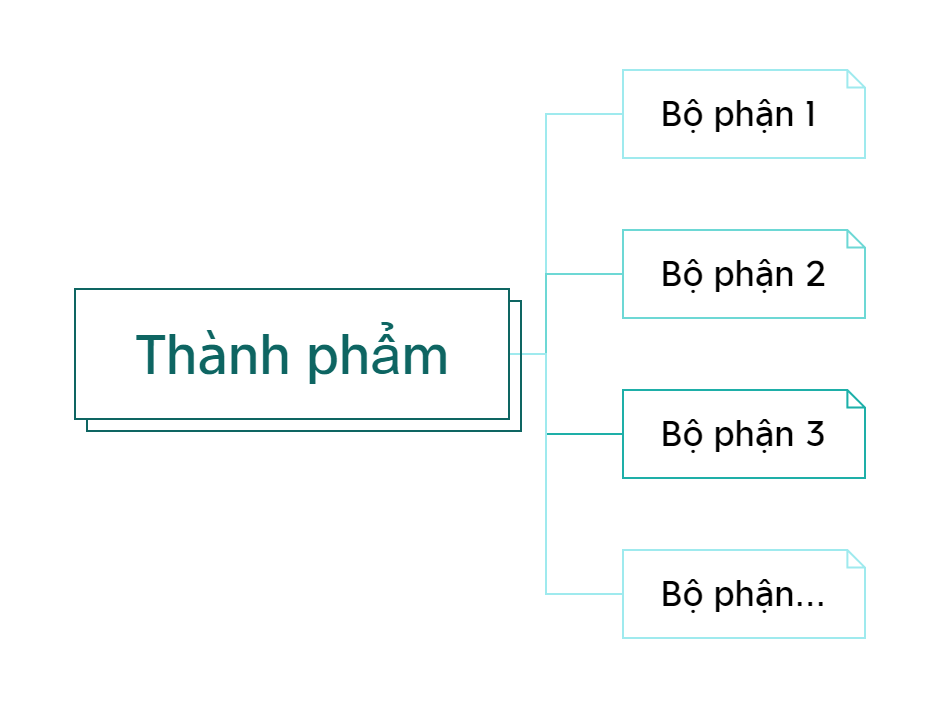 Single-level bill of materials (BOM)
Multi-level bill of materials (BOM)
Unlike a single-level bill of materials, a multi-level BOM shows the relationships (sometimes called parent-child) between components, subassemblies and assemblies.
In turn, a subassembly can consist of many components. When changes are made to an assembly (the parent), they carry down to the subassemblies (the children). Because they show these relationships, most complex products use multi-level BOMs.
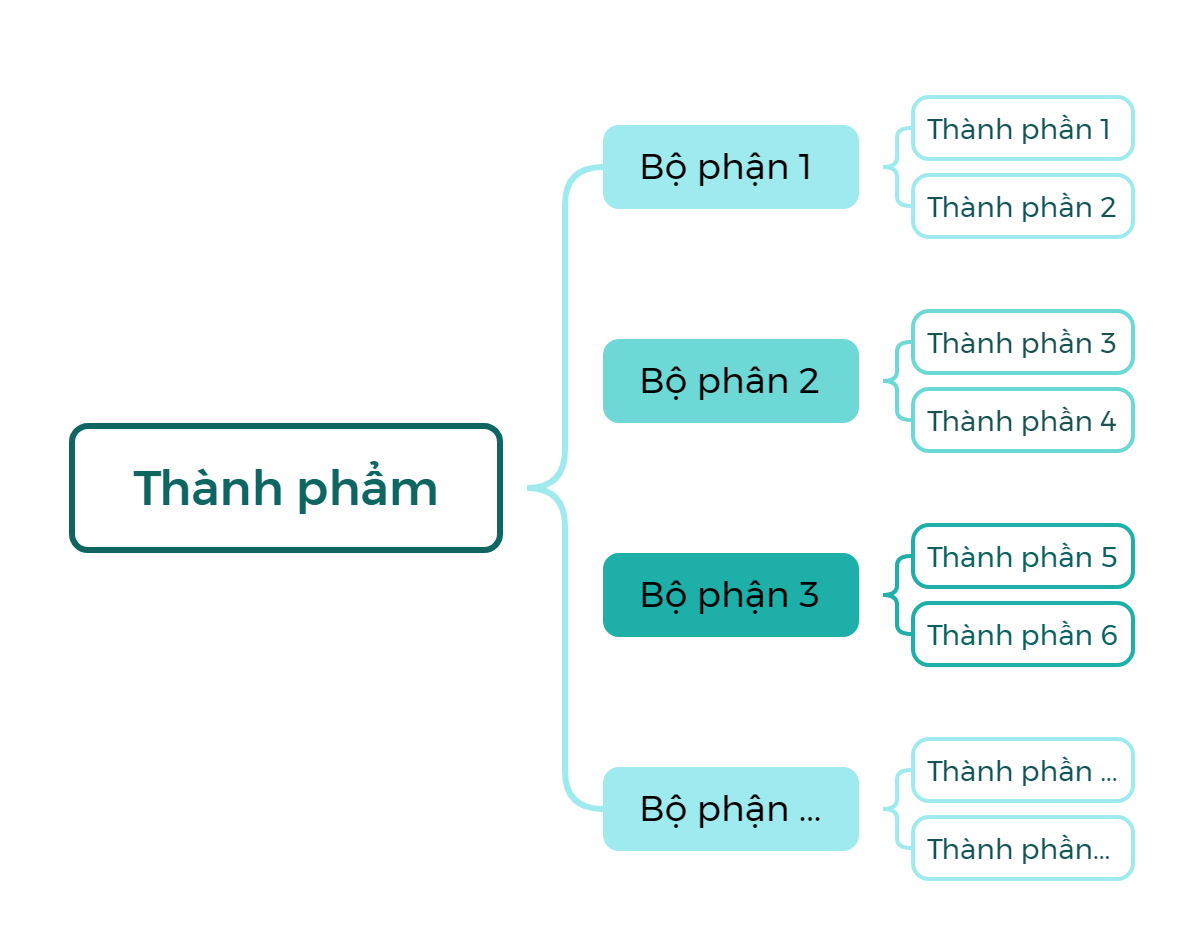
Multi-level bill of materials (BOM)
3 types of bills of materials
Both single-level and multi-level BOMs can be created for use at different stages of the product development lifecycle. The main types are engineering, sales and manufacturing BOMs.
Engineering bill of materials (EBOM)
An engineering BOM is developed while the product is being designed and defines the initial design of the finished product. It includes the items, parts, components and subassemblies specified by engineering. It often includes a technical drawing of the product.
Engineering BOMs, as the name suggests, are usually developed by engineers. They often use computer-aided design (CAD) software or similar systems to create the BOM.
BOM bán hàng - Sales Bill of Materials (SBOM)
A sales BOM lists the products and components needed to develop a product to the customer's requirements. It is developed from the sales order and includes both finished goods and components as they appear in the sales record.
Manufacturing bill of materials (MBOM)
A manufacturing BOM is used during production. It defines the parts and assemblies needed to make a shippable product, including packaging, and accounts for waste and items consumed during production.
The MBOM defines the groups of parts needed at each stage of the production process and provides information on the processing different parts require before assembly. This helps determine when materials must be purchased and when different production processes need to start to meet scheduled delivery dates.
Khám phá: The best production management methods today
For a new product, the MBOM may exist for a certain period, such as a few weeks. After that, if the product clearly requires changes, the MBOM can be updated or a new product can be created.
Information in the MBOM is usually shared with several systems, including enterprise resource planning (ERP) and material requirements planning (MRP) systems.
Real-world BOM examples
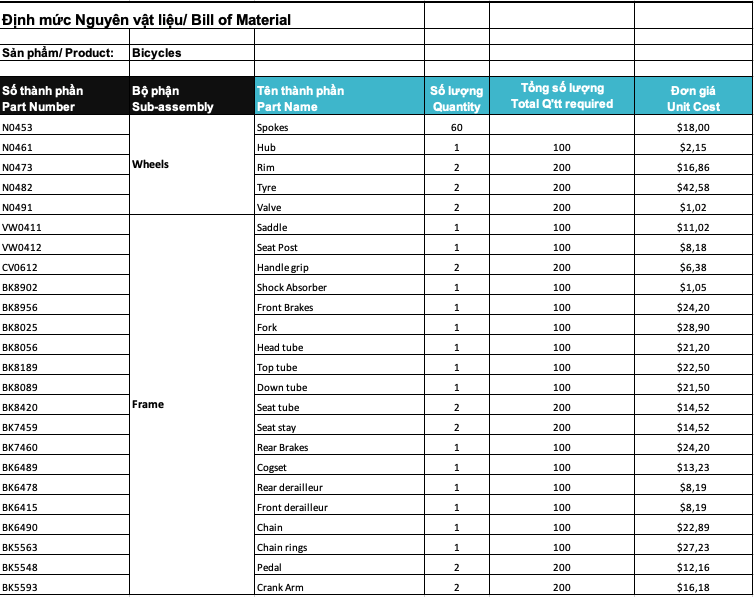
A BOM can be created as a table or a flow chart. Creating a BOM requires knowledge of the field. As a basic example, let's look at producing 100 ‘mountain bikes’.
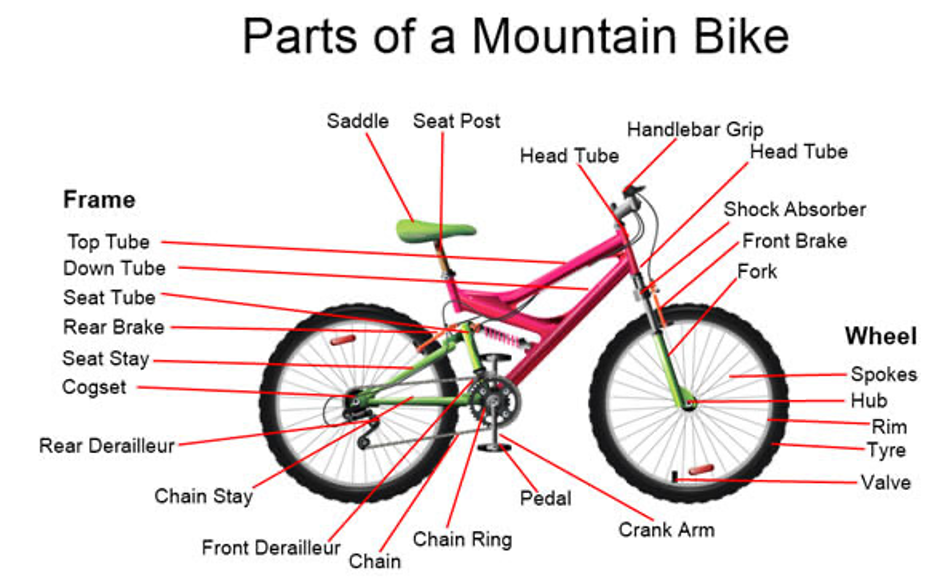
The components of a mountain bike
Flow chart BOM
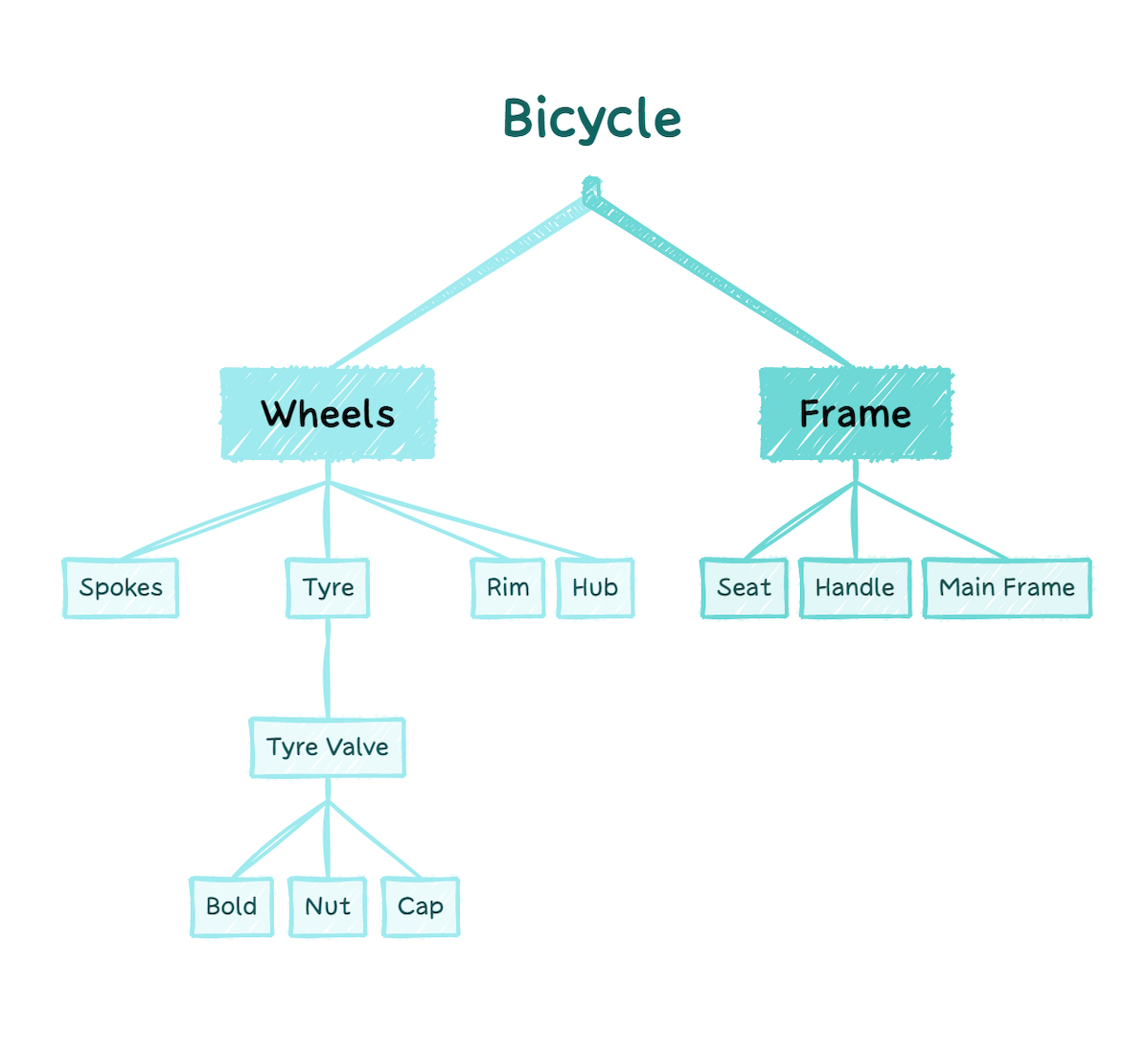
Table BOM
Let's look at another concrete example of a bill of materials (BOM) in garment manufacturing. In this example, the BOM provides complete information on the components, the production process, main products and by-products, quality control (QC) points, the BOM version and production capacity. Through the BOM, you get a complete, visual overview of the entire garment production process.
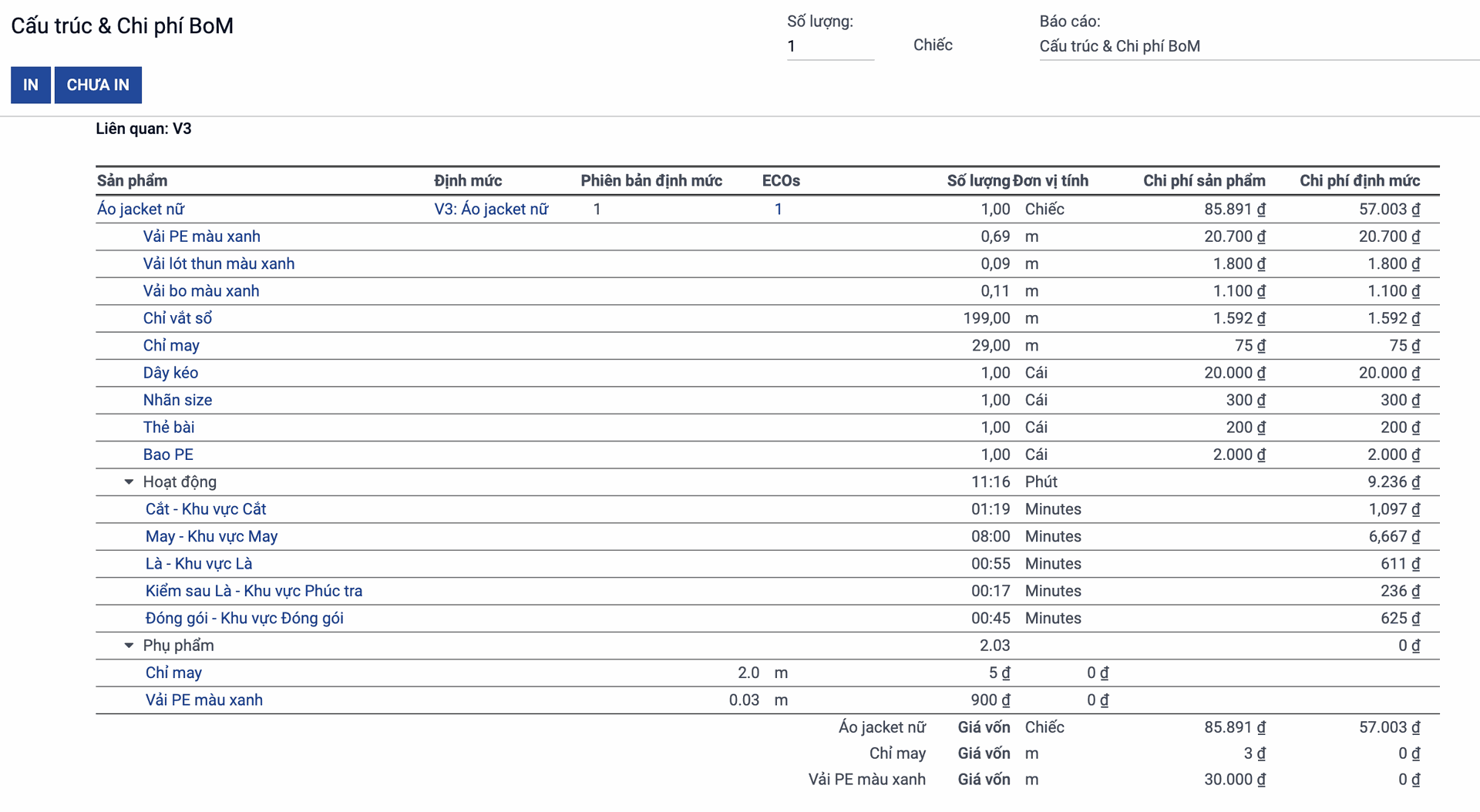
BOM structure and product cost of a women's jacket
10 key elements of a BOM
Most BOMs include the following elements: BOM level; part number, name, description and quantity; cost; and unit of measure. Although a bill of materials includes components and parts, it does not include labor.
Learn more: How does Toyota do lean manufacturing?
#1 BOM level
It can be a single-level or multi-level BOM.
This is a unique number that indicates the position of each part or assembly in the BOM hierarchy. Consider a BOM for a car. Each major component, such as the engine, doors and transmission, would be a level. These would be broken down into components and materials, such as the pistons and crankshaft that are part of the engine. The pistons and crankshaft would themselves be a level and then be broken down into their constituent parts. An example would be the piston rings that are part of the piston.
#2 - Part number
This helps track each part, allowing anyone involved in production to identify it quickly. Part numbers can include some description of the part; for example, a wire's number might be "WIRE-001."
#3 - Part name
A unique name for each item, together with a specific code, makes items easier and more efficient to identify.
#4 - Phase
Indicates the stage of each part in the production process, for example components that are "in production" or "in design."
#5 - Description
Each part should have a full explanation. This helps distinguish between similar parts.
#6 - Quantity
Quantity is the most important requirement of a BOM. It indicates how many parts will be used in an assembly or subassembly.
#7 - Unit of measure
A unit - inches, grams, kilograms, liters, feet, etc. - must be specified for each quantity. Purchasing costs must stay within the budget set for the project. This ensures the right quantities are ordered.
#8 - Procurement method
The parts or items needed can be bought externally or made in-house. Make sure optimal discounts are applied when buying large quantities from the same supplier.
#9 - Images/reference documents
A picture is worth a thousand words. Images help cross-check BOM details. An image of the final product makes each component easy to understand.
#10- Ghi chú BOM
This provides additional information related to the bill of materials beyond the part descriptions.
How to create a BOM in 7 steps
Depending on the industry, designers or engineers as well as purchasing, scheduling and planning staff will want to review BOMs to ensure accuracy — an accurate BOM serves as the roadmap to finished goods and frees up resources to spend on the actual production process. Several steps are involved in creating an accurate, useful bill of materials, including:
#1 - Decide what data to include.
For example, will the BOM include consumables such as glue or wire? Although this may seem unnecessary, including these materials in the BOM from the start helps ensure they are always available when needed.
#2 - Control the BOM centrally.
In many organizations, different departments or functions use different information systems. For the BOM to stay accurate and up to date, it needs to bring information from all these systems into a single record.
#3 - Decide who will be able to change the BOM.
To minimize the risk of errors, the number of editors should be limited.
#4 - Decide how to track changes to the BOM.
Many BOMs are revised constantly. For the BOM to keep providing value and stay accurate, all changes need to be tracked. Make sure every change can be traced back to its author.
#5 - Choose the BOM presentation.
Such as single-level or multi-level, whichever makes sense for the product.
#6 - Start listing.
The materials, components and parts that will make up the product. The list will grow and change over time.
#7 - Keep adding to and refining the list.
Track all changes.
How does a BOM work with ERP and MES systems?
The BOM is a key element in enterprise resource planning (ERP) and manufacturing execution system (MES) systems. It is a fundamental part of managing materials and production processes.
Trong In an ERP system, the BOM is used to store information on a product's components and structure. It is the basis for managing purchasing, inventory control, production planning and costing. The ERP uses BOM information to track and synchronize activities related to materials and production processes.
Meanwhile, the MES is usually responsible for managing and coordinating daily production activities. The BOM is integrated into the MES to ensure the production process follows the defined structure and sequence. The MES uses BOM information to guide workers and equipment through the production process while tracking progress and recording production information.
The BOM is therefore an important link between the ERP and MES systems. It ensures consistency and the exchange of material and production process information between the two systems, enabling effective production management and operations.