If you are considering a smart warehouse management system but aren't sure what it does or how it adds value to your business - such as increasing picking and order fulfilment performance by 50%, increasing inventory accuracy by 48% and improving order turnaround by up to 47%... - then this content is for you.
We will answer some of the most frequently asked questions about managing a smart, modern warehouse to optimize performance, helping you find the organization and choices best suited to your business requirements.
Main contents
Q1: How to arrange goods locations in the warehouse optimally?
Setting up a warehouse efficiently and in an organized way not only supports inventory control and time management but also streamlines the entire business operation, from ordering and storage to picking and shipping.
But what is the best way to organize a warehouse? We have all the information you need to set up your own storage space, step by step:
1. Organize the floor plan for optimal flow
The first step in organizing your warehouse is creating a floor plan. This lets you see where you want to store items, as well as any physical space limits of the warehouse. Putting the plan on paper before you put it into practice helps you visualize the system in use and prepare for any obstacles that may arise. It is important to make sure your system is easy for others to understand and use, so staff can be trained easily and have no trouble putting it into practice.
Pro tip: take a pen and draw a line from where inventory arrives at your facility, to how it is processed and how it leaves. You are hoping for a relatively straight line.
Poll your staff, who work in the space every day. Are there little corners of the warehouse that could be adjusted slightly to support their efforts? Give your staff a voice in this process improvement. Keeping your staff safe and happy will greatly benefit their productivity and your overall success.
Within these groups of items, you can also apply the Pareto principle (the 80-20 rule). This is where you create space in your warehouse for the items that make up the top 20% of sales for 80% of your orders, so they are easier to pick. It may take a bit of upfront work, but this zone of the warehouse can significantly increase picker productivity. It is important that this area can handle high traffic, as it will be used the most.
2. Choose storage and racking solutions
Next, you'll want to choose racking and storage solutions that fit your needs. Focus on quality and quantity. You want enough storage space for the long term. Pallet racking systems are the preferred choice because they are extremely durable and safe and let you make the most of your vertical space. Warehouse racking is the top choice as the foundation of warehouse organization, but there are several types of warehouse racking to choose from, including:
Drive-in racks
Selective racks
Double-deep racks
Mold racks
Cantilever racks
Carton flow racks (flow racks)
Of course, the best choice depends on the nature of your operation, the size and volume of products flowing through your facility and other considerations. You'll also want to consider shipping containers, storage bins and even coolers and freezers if you handle temperature-sensitive inventory. Once your racking is installed and organized in a way that promotes safety and good traffic flow, label all shelves and areas according to your plan.

Storage racks
3. Label racks, shelves, containers and other warehouse assets
Before putting anything in the warehouse, label everything: pallet racks, shelves, docks, everything. Warehouse labeling solutions are specially designed to meet the distinct needs of warehouses, offering various custom options, from long-range reflective labels to cold storage labels, hanging warehouse signs, multi-level rack labels, and outdoor door and dock signs that can withstand the elements. By choosing the right labeling solution, your warehouse will be easier to navigate, picking and packing will be streamlined, and overall organizational efficiency will improve.
Investing in a comprehensive warehouse labeling solution pays off quickly through better inventory control, improved productivity, warehouse optimization and more. Looking up a barcode, SKU or other numbering system to find the right item is much faster and simpler than navigating dozens of aisles to find the right zone, the right shelf and the right product.
4. Maximize space utilization
When stocking your warehouse, it is important to make the most of all the space you have, and that includes optimizing the use of your vertical space. Stacking items or using stacked racks not only saves the most space but also keeps the warehouse neater and more organized.
Placing less frequently purchased items higher up, in narrow aisles or in harder-to-reach areas of your warehouse can help maximize both space and productivity, keeping the fastest-moving items the easiest to pick and close to the loading dock. Product size and weight will also be major factors in how you choose to organize your warehouse.
5. Schedule regular maintenance
Keep your warehouse tidy by scheduling regular cleaning and making sure aisles are clear of items. You should be able to walk through any part of the warehouse at any time without obstruction. Adopting policies and procedures for incoming and outgoing inventory will help ensure your warehouse stays organized and inventory is accounted for accurately.
6. Conduct periodic inspections and reviews
Finally, you'll also want to periodically review your inventory management system and warehouse organization to ensure they are effective. This covers everything from the types of containers and racking systems in use to how items are grouped together. Verify that staff have a working route, identify (and remove) any obstacles and double-check your design to make sure you are maximizing your space.
You should also check for any potential problems with your design so you can deal with them better if they arise. Most importantly, make sure everything is up to code and safe for anyone entering the warehouse.
There's no reason to continue with a process that is unsafe or doesn't work, and by prioritizing regular reviews, you can easily see which aspects of your inventory setup and handling can be improved. This helps increase your productivity and profit.
Q2: How to improve picking and order fulfilment performance by 50%?
Great - now you have a plan for arranging and storing goods, and goods will be organized by rack, shelf, compartment and bin, giving you an overview of the entire warehouse. But beyond that, you need to track the current and past location and status of each shipment/order: the location of each type and group of goods, the exact position of items on the racks and their status, to speed up order processing.
With a smart warehouse system, the professional way to do it is:
For warehouse operations (receiving, issuing, transfers, inventory):
Automate order picking and accurately manage the location and status of goods visually to manage the warehouse, save time and pick the right goods more often, making picking and receiving fast, through:
Real-time updates on orders that need to be received or issued
Automated order picking and location of each item: the system automatically identifies and gives directions on where to store or pick goods on a visual dashboard.
Alerts for stockouts or stock below the minimum level.
Alerts/tracking for quantities above the set level or goods in stock longer than expected…
Modern, online multi-warehouse management.

Warehouse information dashboard
The warehouse information dashboard gives you an overview of the warehouse layout map, goods locations, goods status, orders… with indicators such as:
Red: alerts that an inventory item is out of stock or below its minimum level
Yellow: the quantity of goods is above the set level, or goods have been in stock longer than expected.
Green: goods are within the safe threshold or in normal status
Prioritize minimizing and simplifying tasks for the people who directly issue, receive and transfer goods, so operators can easily find where products need to be stored or picked, specifically:
When there is an order to receive/issue, warehouse staff simply check the order on the warehouse management system dashboard, and the software automatically locates the goods with flashing indicators at the locations where goods need to be picked or stored.
Warehouse staff simply go to the exact location the software points to and either put goods away into storage or pick the goods to be delivered.
Visual management of all goods in the warehouse
The storage and picking guidance board provides information on orders to be received, issued or transferred, and the locations of goods (in green) to be stored or picked for each order.

Automate receiving, issuing and stock counting with barcodes
Use product location and barcode scanning technology or mobile devices integrated with the warehouse management system/software to control receiving and issuing, improving productivity and data accuracy by skipping manual data entry.
For warehouse operations
Process automation: digitize your warehouse management method with a platform that integrates purchase, sales, smart warehouse management, manufacturing… apps and barcode scanners to prevent human error, update information quickly, coordinate effectively in real time and improve all your internal operations, so your customers feel more confident in and satisfied with the service you provide.
Use the replenishment feature to set minimum and maximum stock quantities. The system will suggest purchase orders or requests for quotation. When stock runs out or falls below the minimum level, the system automatically notifies the relevant department, reducing the risk of running out of goods to sell.
Advanced routing to manage any warehouse:

Advanced routing process
Khám phá: Businesses struggling to integrate an ERP system for smart warehouse management
Q3: How to improve inventory accuracy by 48%?
Inventory accuracy is extremely important; the challenge lies in achieving it. Out-of-stock items cause lost profit, but paying to store and move inventory also hurts profit. To steer your company in the right direction, here are the best practices SmartBiz shares:
Regular cycle counting minimizes human error and provides more up-to-date, accurate inventory data for managing cash flow.
Add images with product descriptions in your inventory database to improve purchasing and receiving, increase accuracy and prevent misplaced inventory.
Implement a warehouse control system to manage inventory in real time, update inventory automatically and track problem goods, such as perishable stock, fragile equipment or obsolete materials. Carry out regular preventive maintenance on warehouse machinery and equipment if the manufacturer requires it. Catalog data on problem inventory locations, costs and quantities to track shelf life and prevent waste.
Organize audits by category and cycle count smaller samples of inventory on a predictable schedule for more accurate financial data.
Read more: A guide to efficient warehouse management processes that eliminate 95% of costs for businesses
Q4: Traceability of warehouse operations?
Workflow inconsistencies often occur when individuals in the organization cannot fully grasp and understand the activities happening at each level of the supply chain.
Visibility and transparency across all supply chain activities are therefore needed to improve workflows, save manual work time, reduce production waste, increase profit and improve the customer experience.
Accurately capturing the quantity, location and condition of materials and goods helps prevent unexpected situations that could disrupt the production line, such as supply shortages or poor-quality materials.
When goods arrive, their origin, specifications and quality can be checked, so their source and quality can be traced.
Track inventory movements, such as the time and location from purchase, through receipt of finished goods/goods, to issue.
Attach the history of all activities, such as picking, ordering, delivery and quality control, for full traceability.
Details of goods and finished product movements: product name, code, quantity, status…
Managers can also manage and verify goods through the software, ensuring a transparent, efficient supply chain, saving costs and time and improving customer satisfaction.
Inventory traceability report
Q5: Inventory forecasting?
Accurate inventory forecasting is invaluable, especially at a time when supply chains and consumer demand are changing rapidly. Getting accurate forecasts requires a combination of data analysis, industry experience and deep insight into customers and future demand.
Market forces can change quickly, and something as seemingly trivial as a TikTok influencer's product placement can clear out your stock in seconds.
Some factors can have a significant impact on revenue, while others have only a slight effect. The essential data elements needed for accurate inventory forecasting include:
Current stock levels
Outstanding orders
Historical trend lines
Forecast period requirements
Expected demand and seasonality
Maximum possible stock level
Sales trends and velocity
Customer response to specific products

Inventory forecasting methods
At a strategic level, forecasters need deep insight into the organization's goals, local and global supply chain challenges, planned marketing campaigns and promotions, potential media influence and the competitive landscape.
Inventory forecasting helps you have enough product on hand without wasting precious storage space on products you don't need.
Various formulas can help you get started by determining how long it takes for products or component parts to reach you after you order them, when you should reorder stock and how much stock you need to meet peak demand.
Automated inventory forecasting
Smart warehouse management software can help you automate inventory forecasting, as well as other tasks such as calculating inventory turnover, providing valuable insight into how efficiently inventory is managed, current on-hand quantities, forecast inventory replenished from orders, orders to be sold, orders to be processed and maximum/minimum stock levels, to calculate forecast inventory for each item and point in time in real time.
Learn more: The essential guide to inventory planning
Q6: Measuring inventory management effectiveness?
Managing inventory in a warehouse is labor-intensive, with steps such as receiving and putaway, picking, packing and shipping. The challenge is to carry out all these tasks as efficiently as possible.
With valuable insight from inventory performance metrics, businesses can improve cash flow, reduce operating costs and increase customer satisfaction. Some of the important warehouse performance metrics we want to cover are: inventory turnover, delivery cycle time, receiving cycle time, delivery delay, receiving delay and delivery/receipt progress tracking.
1. Inventory turnover
The inventory turnover ratio is the number of times a company has sold and replenished its inventory over a specific period. The formula can also be used to calculate the number of days needed to sell inventory.
The inventory turnover ratio measures how well a company generates sales from its inventory.
How to calculate the inventory turnover ratio (ITR)
The standard method uses market sales information or cost of goods sold (COGS) divided by inventory.
Start by calculating average inventory for a period:
Average inventory = (beginning inventory + ending inventory)/2
You can use ending inventory instead of average inventory if the business has no seasonal fluctuations. However, more data points are better, so divide the sum of monthly inventory by 12 and use the annual average inventory. Then apply the inventory turnover formula:
Inventory turnover ratio = Cost of goods sold / Average inventory value
A higher ratio is more desirable than a low one because a high ratio tends to indicate strong sales. In general, a higher ratio means strong sales are depleting your stock quickly. However, it can also mean you aren't buying enough inventory or that you lack supply chain visibility, which is limiting the sales you can make. That is an opportunity, if you can increase your stock of popular items.
A low ratio needs some inventory analysis to uncover the cause. Are competitors offering lower prices? Then review your pricing strategy. Is market demand for these goods declining? Is the purchasing strategy no longer working and inventory piling up? Then consider adjusting your purchasing policies and processes accordingly to avoid tying up too much capital in inventory.
Is the sales team underperforming? Consider training to address how purchasing decisions are made today, or stress the need for sales leaders to make realistic rather than overly optimistic predictions.
Finally, the formula can also be used to calculate how long it will take to sell through current inventory. Days sales of inventory (DSI) is calculated like this for a daily context:
(Average inventory value / Cost of goods sold) * 365
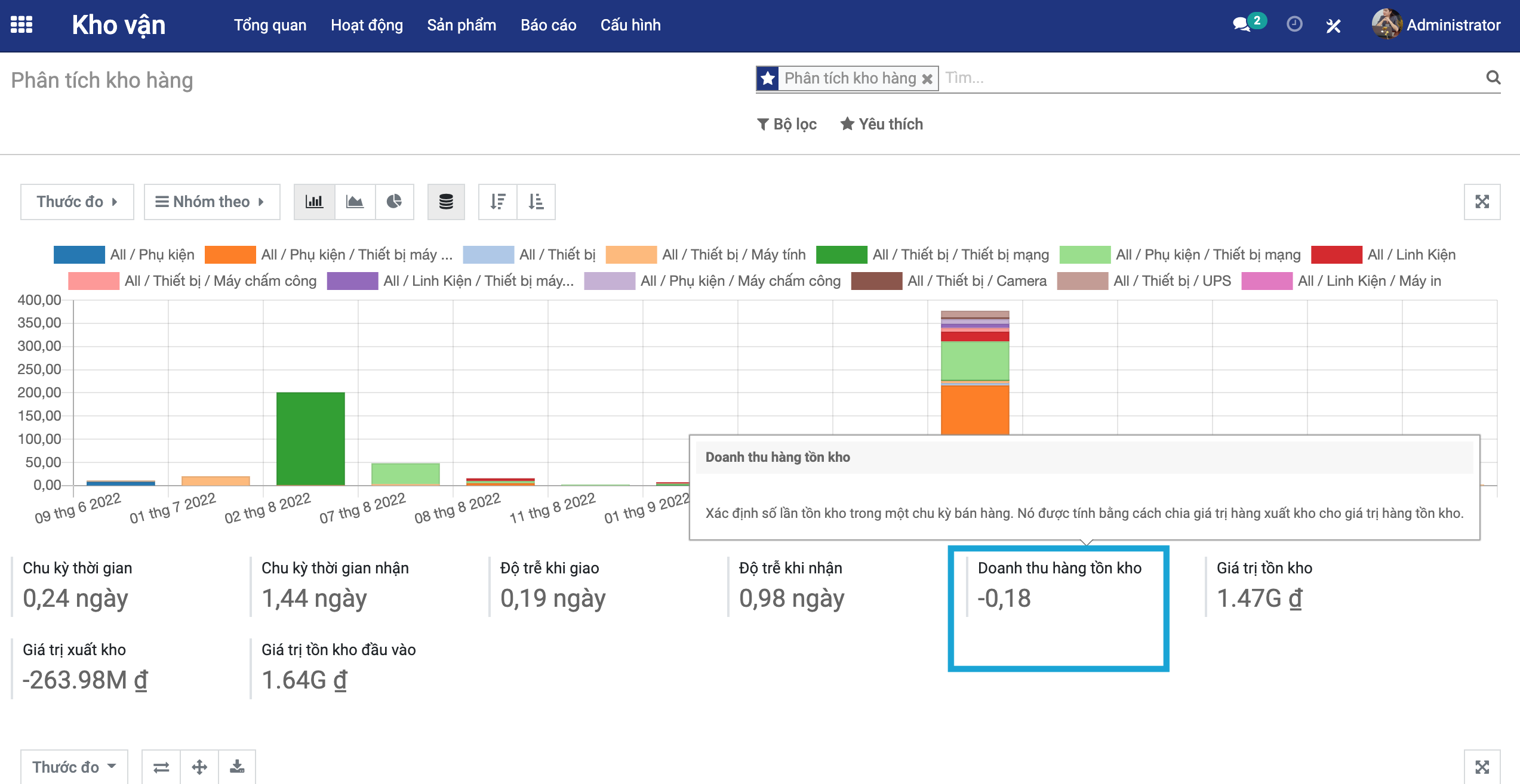 Warehouse analysis report - inventory turnover metric
Improve inventory turnover with smart warehouse management software combined with an ERP system that automatically calculates and raises alerts to improve turnover by modernizing and optimizing inventory processes and policies, with automatic orders and real-time data giving you more control, faster and more accurately.
2. Delivery and receiving cycle time
This is the time needed to deliver or receive goods, calculated from when the delivery order or receipt order is created until the order is actually shipped out or delivered in. This makes it one of the most important KPIs for tracking your order fulfilment, as it helps you measure your operational efficiency and can act as a competitive advantage for the business.
Average delivery cycle time = (Delivery date - Delivery order creation date) / total orders delivered
Average receiving cycle time = (Receipt date - Receipt order creation date) / total orders received
The shorter the delivery cycle time, the more responsive the company is to customer orders.
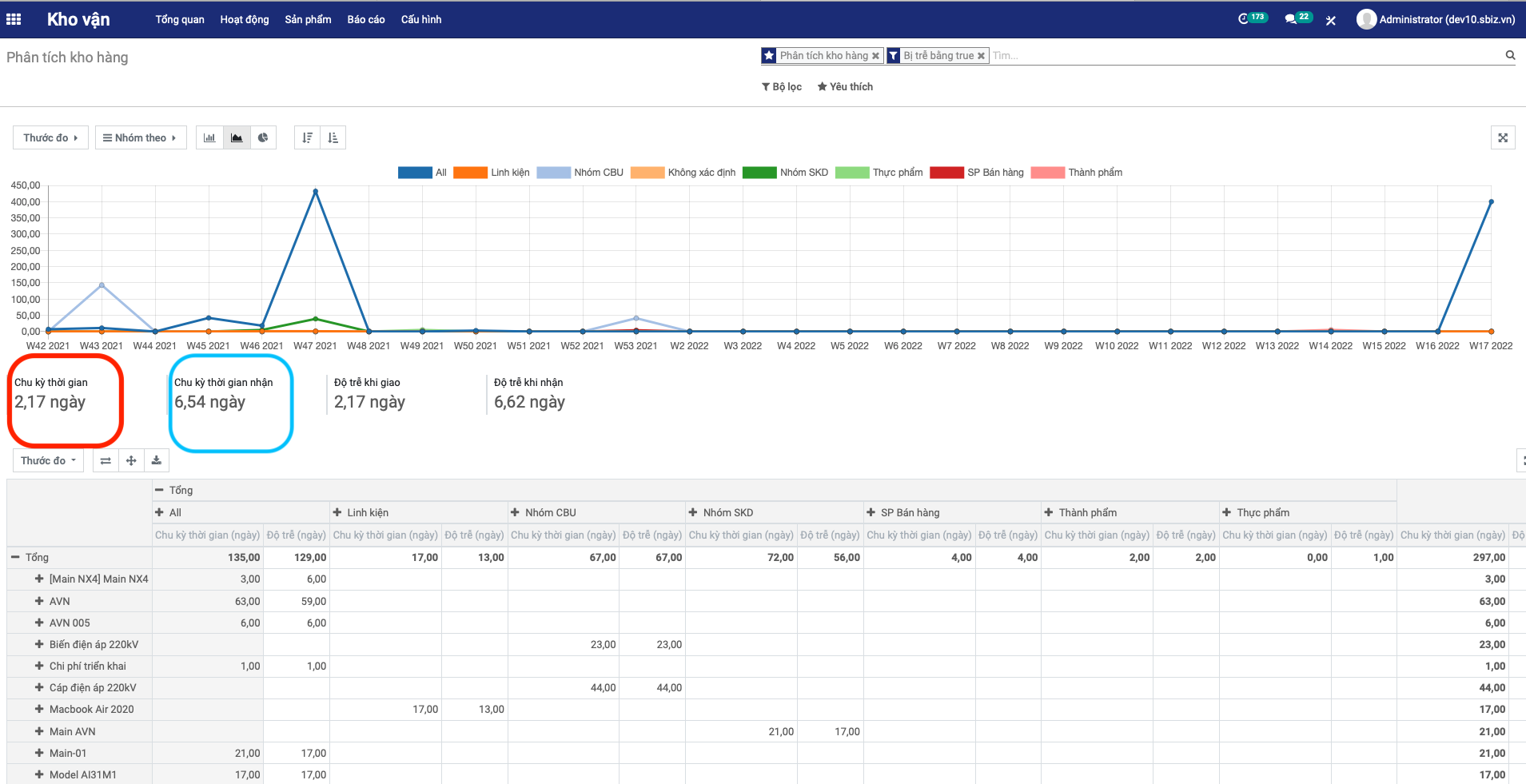
Delivery and receiving cycle times are calculated automatically by the software
With a smart warehouse management system, this metric is automatically calculated and continuously updated from data on orders, the creation dates of delivery/receipt slips and the completion dates of deliveries/receipts by product group, item… helping businesses monitor and make timely decisions.
3. Delivery and receiving delays
There are many causes of delivery delays. An efficient warehouse must run like a well-oiled machine from the moment a shipment arrives until a product is sent to the customer. Each order goes through a series of steps before it leaves the warehouse, and those steps must happen efficiently. If one of those steps takes longer than expected, the entire operation can be disrupted.
Delivery or receiving delay is calculated by comparing the scheduled delivery/receipt date (expected date) with the actual delivery/receipt date.
Average delivery/receiving delay = (Expected delivery/receipt date - Actual delivery/receipt date) / total orders delivered/received
Managers are always looking for ways to reduce delivery/receiving delays, which promotes the smooth running of all warehouse workflows and prevents delivery delays caused by disorientation and lost time.
4. Delivery and receiving progress
"Where is my order/shipment? What is the estimated time of arrival (ETA)? Is the order being delivered as planned, or has there been a disruption? ..." This is the information every manager wants in order to control their goods and orders. As supply chains become increasingly complex, real-time visibility becomes ever more important. It helps managers track and trace the exact physical location of items, from raw materials to finished goods, and from storage to picking, packing, shipping and getting products into consumers' hands. More and more businesses are looking for new technology solutions to increase visibility and transparency across every stage of the supply chain.
To clear these bottlenecks, a smart warehouse management system can provide a wealth of information such as package location, waybill number, customer information, order number, quantity, quantity delivered, quantity still to be delivered, percentage of goods delivered, weight, delivery status and date, and delivery/receipt delays by order and over time...

The reporting tool provides complete, continuously updated information on delivery/receipt progress by time, quantity or percentage delivered
As a result, warehouse managers and operators can check and track the status of their shipments at any time and quickly spot shipments that are delayed, lost or damaged, excess or missing items in transit, etc.
This information lets managers proactively resolve problems as quickly as possible, ensuring shipments are delivered according to process, on schedule and with the right quality.
Conclusion
Supply chain visibility is gradually becoming essential for all distributors, manufacturers and carriers... It simplifies finding, tracking and collecting data from every activity in the warehouse.
With a smart warehouse management system, managers will have the most accurate information about their goods, improving their management capability and visibility and optimizing operational quality, performance and customer satisfaction.
The SmartBiz smart warehouse management solution is ready to deliver a collection of automated warehouse control and optimized warehouse management features that overcome the biggest inventory management challenges. Track inventory across multiple locations, automatically manage reorder points, forecast demand and use a set of visual performance analysis reports. The system is fully integrated with purchase, sales, manufacturing, accounting… apps and with mobile devices and barcodes (or RFID tags) on the powerful ERP platform ranked 4th in the world.
Is this the kind of warehouse management you are interested in, and would you like a similar smart, optimized warehouse management system? If so, contact SmartBiz now and get advice and support from our experts as soon as possible!