In the race for business success, the most important goal is to create products that meet customer needs quickly and cost-effectively. But how do you do that? Production planning is the key that opens the door to success.
It is not just a plan but a solid fortress covering all the processes, resources and steps involved in production. From forecasting demand to determining the materials, labor and equipment needed, production planning shapes the execution strategy.
Planning or not planning production can significantly affect risk and performance in a manufacturing business. Here are some interesting figures you may not know:
1. Risk:
· Defect and non-conforming product rates are 25% higher without a production plan (source: American Productivity & Quality Center).
· More than 70% of production incidents and breakdowns can be avoided through planning and risk management (source: Association for Operations Management).
2. Performance:
· Businesses with a production plan have on-time completion rates 90% higher than those without (source: Aberdeen Group).
· Using a production plan can increase staff productivity by up to 25% (source: Institute of Business Forecasting & Planning).
This guide gives you a complete understanding of production planning and how it can help you allocate your resources efficiently and cost-effectively to fulfill customer orders. So read on to learn how to improve production scheduling in your growing manufacturing business.
Contents
1. What is production planning?
2. What is the difference between production planning and production scheduling?
3. Why is production planning important?
4. Types of production planning
5. A 5-step production planning process
6. 3 common production planning mistakes
What is production planning?
Production planning is an important process of strategic decision-making to determine the optimal production strategy, allocate resources and plan to meet customer demand and organizational goals. It includes a comprehensive analysis of which products should be made, in what quantities and when.
By considering market demand, sales forecasts and internal capabilities, production planning ensures resources are used efficiently while maintaining a competitive edge. The process plays an important role in aligning the overall business strategy with the operational side of production, letting companies meet customer expectations, maximize productivity and achieve the desired results.
What is the difference between production planning and production scheduling?
While production planning provides an overview of what the company intends to do, production scheduling creates a more detailed view of exactly how it will do it. The production schedule describes when each step of the production plan takes place, as well as the workers, machines and other specific resources assigned to the work. Production scheduling can be extremely complex, especially when there are many interdependent production steps and the company makes many products at the same time. Production scheduling software can help businesses create complex schedules, track progress in real time and make adjustments quickly when needed.
Production planning vs. production scheduling
| Production planning | Production scheduling |
|
Goal: production planning focuses on determining the steps, resources and processes needed to carry out production. It includes making strategic decisions and identifying key factors such as demand forecasts, materials, labor and equipment. |
Goal: production scheduling focuses on arranging timing, specific schedules and work assignments to make sure production runs on time. |
|
Scope: production planning is broader and includes the strategic factors needed to achieve production goals. It involves key decisions and sets the main direction for production operations. |
Scope: production scheduling focuses on specific activities and arranging tasks within specific time frames. |
|
Timing: production planning is usually done before production starts. It can include setting long-term and short-term plans. |
Timing: production scheduling is usually done during production to arrange detailed timing and schedules. |
|
In short: production planning Forecasts customer demand and market trends Sets production targets Determines the types and quantities of products to make Allocates resources efficiently Builds the production plan and timeline |
In short: production scheduling Sequences production tasks Assigns resources (equipment, labor, etc.) to specific tasks. Minimizes idle time and maximizes resource utilization Adapts to changes in customer demand or unexpected disruptions. Ensures timely product delivery |
Why is production planning important?
A well-built production plan can increase revenue, profit and customer satisfaction, while a poorly designed plan can cause production problems and even sink a company. The specific benefits of production planning include:
1. Greater efficiency: production planning increases efficiency in production operations. It helps optimize resources, processes and technology to achieve the highest efficiency in making products or services. By determining the resources needed in advance - materials, equipment, labor and time - the company can ensure resources are supplied and used sensibly, avoiding shortages or waste.
2. Meeting customer demand: production planning lets the company meet customer demand accurately. By identifying and forecasting market demand, the company can plan production based on the quantity, quality and timing needed to meet customer demand effectively and on time.
3. Ensuring quality: production planning helps ensure the quality of products or services. By defining detailed production processes, quality control and periodic inspections, the company can make sure the final product meets quality standards and customer requirements.
4. Fast adjustment and response: production planning provides the ability to adjust and respond quickly when problems occur.
Types of production plans
How a production plan is designed depends on the production method the company uses, as well as other factors such as the product type, equipment capabilities and order sizes. Here are three of the main types of production planning:
Batch production planning.
This refers to producing identical items in groups rather than one at a time or in a continuous process. For some businesses, batch production can greatly increase efficiency. A bakery making items to sell the next day might first make a batch of chocolate chip cookies, then switch to oatmeal raisin cookies, then loaves of semolina bread. A clothing manufacturer producing goods for summer might first set up its cutting and sewing machines to make 500 navy T-shirts, then switch to red fabric and thread to make 400 tank tops. A good production plan for batch processing should consider possible bottlenecks or delays when switching between batches.
Job- or project-based planning.
Used by many small and medium-sized businesses, job production planning focuses on creating an item by one person or one team. Job-based planning is often used when the specifics of each customer request make mass production difficult. Many construction businesses use this method. Custom jewelry and clothing makers are other examples of businesses that may use job production planning.
Flow production planning.
In flow production, also known as continuous production, standardized items are mass-produced continuously on an assembly line. Large manufacturers use this method to create a continuous stream of finished goods. During production, each item must move seamlessly from one step to the next along the assembly line. Flow production is most effective at reducing costs and delays when there is stable demand for the company's products. Manufacturers can then easily determine their needs for equipment, materials and labor at each stage of the assembly line, helping streamline production and avoid delays. The automotive industry and canned food and beverage makers are among the companies that use this method.
A 5-step production planning process
Production planning is an important and powerful process that starts with forecasting and continues with designing and monitoring the production process. Here are five notable production planning steps:
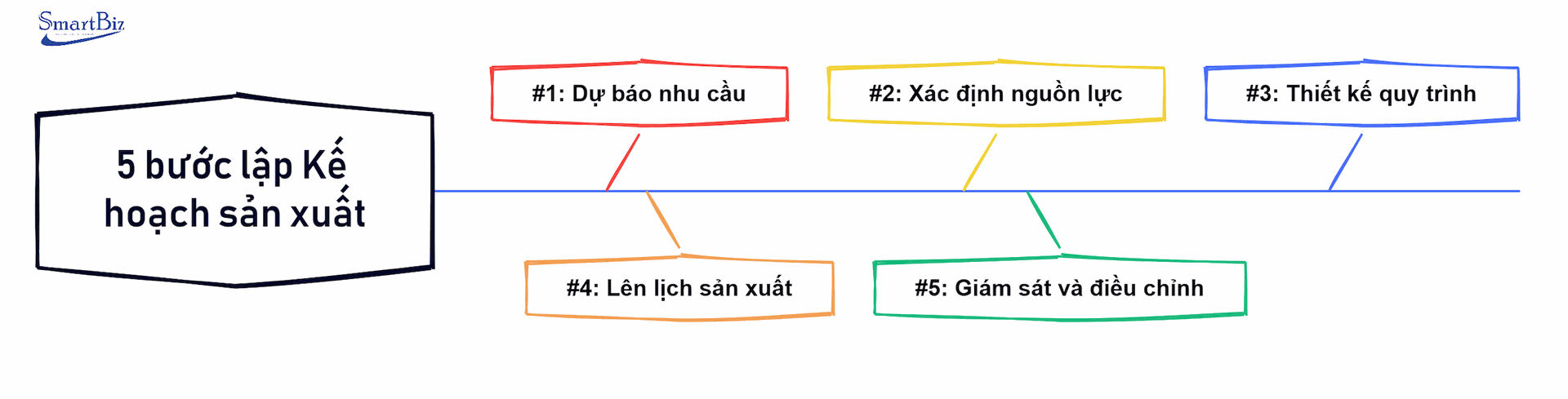 The production planning process
#1: Forecast demand
The first step in production planning is forecasting market demand. Based on information from customers, market trends and historical data, the company analyzes and estimates future product demand.
#2: Identify resources
After forecasting demand, the company identifies the resources needed to meet production needs. This includes determining materials, equipment, labor and other factors to ensure the production process runs smoothly.
#3: Design the process
The next step is designing the detailed production process. The company defines the specific steps to make the product from start to finish. This includes determining the sequence of work, quality control processes and the division of work among teams.
The production flow chart shows which steps depend on each other and which can be done at the same time. Suppose the job is to make 1,000 children's bicycles. Making the bicycle frames involves a series of steps that must happen in sequence — cutting metal tubes, welding and painting — while other activities such as assembling the wheels can happen in parallel. Do you have all the right equipment? What happens if a machine breaks down? Can your suppliers meet your needs?
Khám phá ngay: Expert guidance on managing material consumption norms
#4: Schedule production
After designing the process, the company schedules production according to the designed plan. By allocating time and resources to each production step, the company makes sure the process runs on schedule and matches market demand.
#5: Monitor and adjust
Production planning does not stop at design and scheduling; it also includes monitoring and adjusting the production process. The company tracks production, checks quality and responds quickly to make sure production runs efficiently and meets customer requirements. Football coaches often adjust their game plan at half-time — and the same is true of production planning.
3 common production planning mistakes
Product planning is an important process in product management and development. However, there are some common mistakes people often make in this process. Here are three common production planning mistakes you should avoid:
Not anticipating problems along the way.
In any complex production process, plans can go wrong. So the production plan should include risk management strategies, including contingency plans the company can rely on if problems arise. Failing to do so can lead to serious problems. For example, if a machine breaks down on the line and you have no budget for repairs and overtime, the problem can strain the company's finances.
Read now: The product management process and secrets of effective production management
Keeping your distance.
Although production management software can provide real-time visibility into the company's production status, you should supplement that information with in-person visits to the production line. Those visits can provide valuable insights into how production actually works — insights you may not get if you are stuck behind a desk.
Not maintaining equipment.
Tracking usage and paying for regular preventive maintenance helps ensure your machines can keep your business running.
Production planning performance metrics
Key performance indicators (KPIs) play an important role in assessing the state of a company's production processes. They provide information that helps businesses track and evaluate the effectiveness of production. By comparing KPIs with the target values set in the production plan, businesses can assess whether production is on track and clearly identify the problems to be solved. Here are some typical production KPIs:
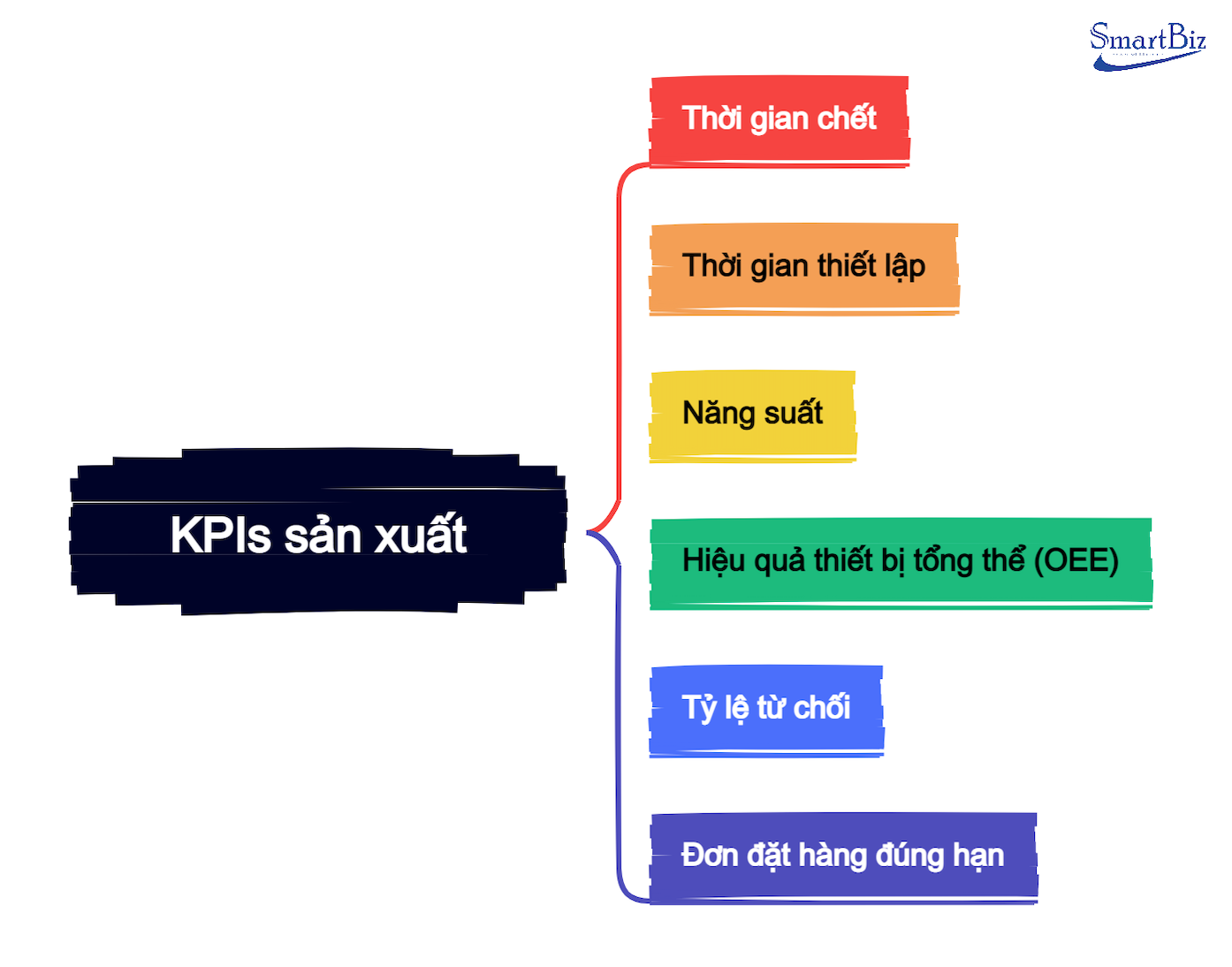 Production KPIs
Downtime.
This key performance indicator tracks the percentage of time production is not running during scheduled operating hours. Causes include machine breakdowns, tool adjustments and accidents. Some downtime may be necessary for functions such as machine maintenance, but in general, the less downtime the better.
Setup time
Also known as changeover time, this is the time needed to switch between jobs. Setup time affects overall productivity because production is paused during these periods. The production schedule should consider how much time and effort it takes to reconfigure production for each job, including changes to equipment, raw materials and the workforce. Designing the production schedule to minimize changeover time can increase efficiency.
Productivity.
In a production environment, this is usually measured by the number of units produced in a specific period. Comparing the actual production rate of each process with the planned rate can help businesses identify strengths and weaknesses and start solving problems.
Overall equipment effectiveness (OEE).
This is a measure of overall production productivity that covers quality, performance and availability. The formula for OEE is:
OEE = quality x performance x availability
Quality is usually measured as the percentage of parts that meet quality standards. Performance is the speed at which a process is running compared with its maximum speed, expressed as a percentage. Availability is the percentage of uptime during the company's scheduled operating hours. OEE can be increased by reducing downtime, reducing waste and maintaining a high production rate.
Read more: What is OEE, and why does every business care about it??
Rejection rate.
This is the number or percentage of products that fail quality inspection. Depending on the nature of the product and the problem, some rejected items can be recovered by reworking them, while others may need to be scrapped.
On-time orders.
Production delays can be costly in both money and reputation. Making products on schedule means you are less likely to need expensive expedited shipping or other emergency measures to meet deadlines. And delivering orders on time keeps customers happy, which means they are more likely to keep doing business with your company.
Production planning tools
Businesses rely on a variety of tools to build production plans and track progress, from visual tools to sophisticated software that automates many of the steps involved. Typical tools include:
Gantt charts.
A Gantt chart is a detailed visual timeline of all the tasks scheduled for a particular job. More than 100 years after it was invented by mechanical engineer Henry Laurence Gantt, the chart remains indispensable in manufacturing and many other industries. Production planning involves coordinating and scheduling many tasks, and a Gantt chart visually shows when each task will take place and how long it will take. However, creating and updating Gantt charts manually to reflect a complex, constantly changing production schedule can be time-consuming and error-prone.
Spreadsheets (Excel).
Small companies sometimes start by tracking simple production plans in Excel spreadsheets. For most companies, however, the inherent complexity of production planning quickly outgrows the capabilities of spreadsheet software. It is not powerful enough to manage production effectively.
Production planning software.
Production planning involves a range of activities, including forecasting, supply chain management, inventory tracking and work scheduling. These activities require information from across the company and beyond. Production planning information is essential to business operations and is used by other teams in the company, including finance. That is the main reason many companies use an enterprise resource planning (ERP) suite that includes production planning software and provides a single solution for managing the entire business.
Managing and optimizing production with SmartBiz
Sticking to the real schedule is what production planning aims for, to make sure the production process runs smoothly and efficiently. It is also an important tool for adjusting operations when problems arise. With a single overview, you can fix problems, optimize operations and make sure progress doesn't stall.
SmartBiz smart production management software helps companies increase production productivity and reduce costs. With SmartBiz, businesses get modern features to track and manage every aspect of the production process, from inventory control to monitoring production stations and fulfilling orders.
Integrated with an ERP and IoT suite, SmartBiz provides real-time visibility, shares production progress across the whole organization and connects the production process with financial reporting, inventory management and order management. This ensures connected, accurate information between departments, from production to operations management and accounting.
Production planning is a key function in SmartBiz, helping optimize output, meet customer demand and increase production efficiency. It also helps identify and fix production problems quickly.
Discover and experience a smart production management solutionthat brings growth and success to your business.