Easing the pain of inventory problems is always a challenge. Are you facing challenges or difficulties in warehouse management? What is the optimal solution to these problems? How do more than 5,000 large businesses around the world build smart warehouse solutions?
Contents
The 19 costliest challenges in warehouse management
Effective warehouse management solutions to its challenges
How more than 5,000 large businesses successfully build smart warehouses
What is a smart warehouse?
How do successful businesses build smart warehouse systems?
1. Optimal inventory management
2. Best practice: walk, crawl, run
3. Assess your current state and future requirements
4. Get the right product. Place it at the right time.
5. Additional tips for a smart warehouse system
Measuring warehouse management effectiveness by inventory type
Get ready and get started
The 19 costliest challenges in warehouse management
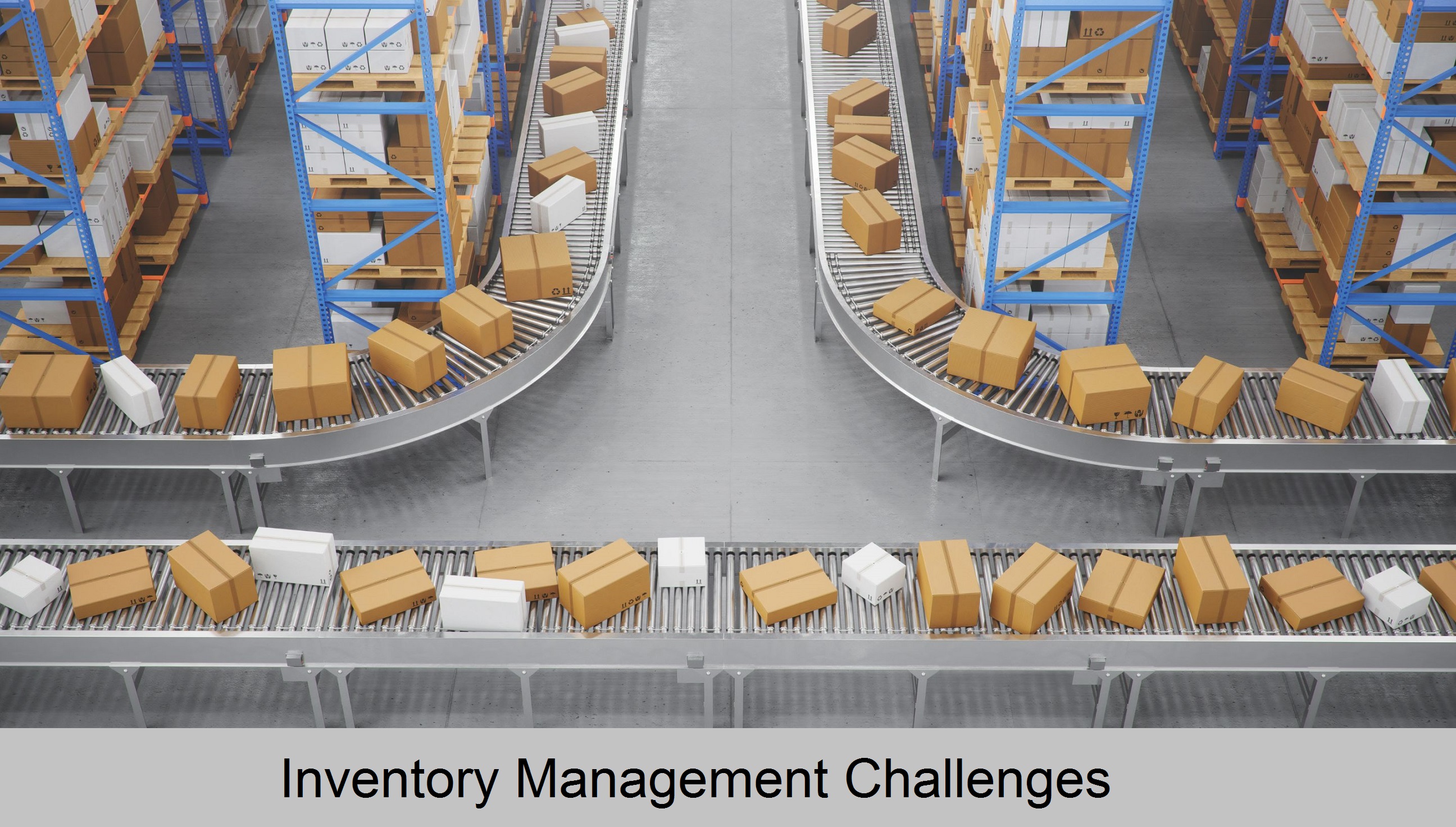
Warehouse management problems
The recent rise in e-commerce sales, growing customer expectations and unforeseen supply chain disruptions have converged to make inventory levels especially important for manufacturers, distributors, wholesalers, retailers and e-commerce companies.
Without strong reporting capabilities and the ability to know exactly where everything is at any moment, you will just spend a lot of time chasing information instead of focusing on building your business.
Here are 19 challenges to watch in your supply chain:
Using manual inventory tracking processes across different software and spreadsheets is time-consuming, redundant and error-prone. Even small businesses can benefit from a centralized inventory tracking system that includes accounting features.
Controlling inventory management in the warehouse is labor-intensive and involves several steps, including receiving and putaway, picking, packing and shipping. The challenge is to carry out all these tasks as efficiently as possible.
You need to know, at any moment, exactly what inventory you have.
Customer demand is constantly shifting. Holding too much can lead to obsolete inventory you can't sell, while holding too little can leave you unable to fulfil customer orders.
When your inventory is hard to identify or can't be located in the warehouse, the result is incomplete, inaccurate or delayed shipments. Receiving and finding the right stock is key to running the warehouse efficiently and delivering a positive customer experience.
Managing inventory with paperwork and manual processes is tedious and unsafe. And it doesn't scale easily across multiple warehouses with many goods.
Perishable and fragile goods need specialized plans for care and storage. And high-value inventory needs specific loss prevention and inventory control strategies.
Global supply chains change daily, putting a burden on your inventory planning and management. Manufacturers and wholesale distributors dictating when, where and how your inventory ships requires flexibility and brings unpredictable lead times.
9. Warehouse space management
Managing space efficiently is a daunting task. Planning and designing warehouse space with an inventory management platform gives you better control over lead times in a new warehouse.
One of the most common challenges in proper inventory management is preventing stockouts of goods for sale.
Globalized supply chains are subject to unpredictable economic change and market forces that affect competition for raw materials. Small businesses sometimes face a choice between competing for high-demand materials or holding enough inventory to control costs.
Many online retail strategies eliminate the need for large warehouse distribution centers. These strategies make it easier to expand inventory and diversify product lines, but they require technology and resources for ordering, shipping and tracking.
Overstocking affects a business's cash flow and leads to inventory-related problems such as storage and shrinkage.
Losing inventory to spoilage, damage or theft can be a supply chain problem. It requires identifying, tracking and measuring problem areas.
Production planning is crucial to avoid delayed production and rising costs. If not done well, it can affect sales forecasting and project planning
It is hard to find highly skilled inventory managers who are proficient in the latest technology and can improve inventory strategy. Simply upgrading your warehouse management platform with a range of features isn't enough. You need management capability.
Communication and collaboration are key. When departments are indifferent to sharing information, identifying inventory trends and finding ways to improve become much harder.
Manual, low-tech inventory management processes may not seem like a tough challenge when inventory is small and there is only one warehouse location to manage. But as sales volume grows and inventory expands, standard operating procedures that are
inefficient, labor-intensive and low-tech become hard to scale.
19. Unsuitable software
To scale a warehouse management system, it needs to integrate with your existing business process platforms. The tough task is choosing from hundreds of inventory management solutions and mastering a range of features that require ongoing training and support.
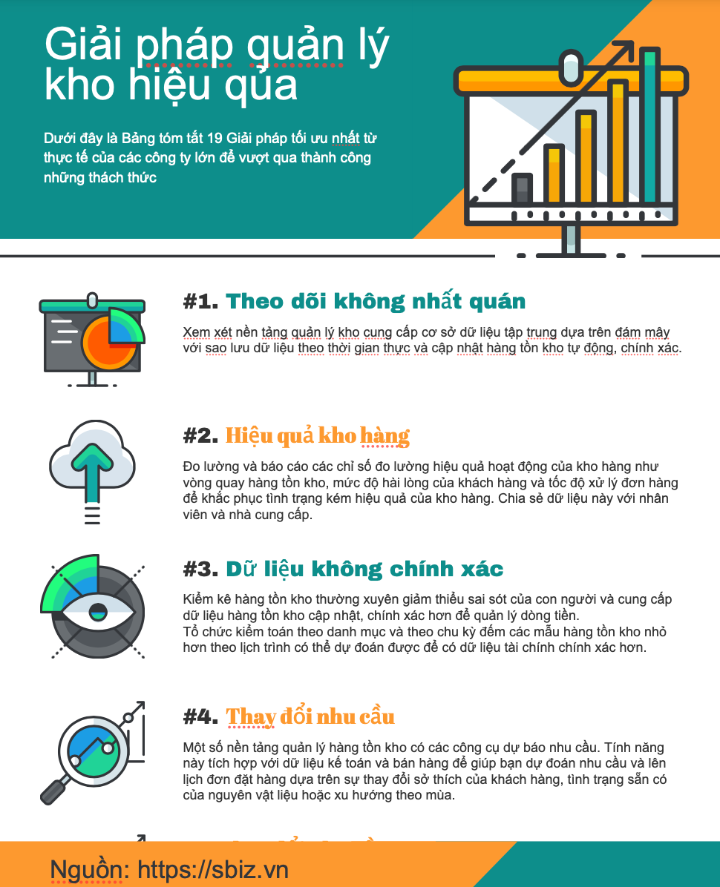
The most effective warehouse management solutions for your warehouse management challenges
STT | Challenge | Solution |
1 | Inconsistent tracking | Consider a warehouse management platform that provides a centralized cloud-based database with real-time data backup and automatic, accurate inventory updates |
2 | Warehouse efficiency | Measure and report warehouse performance metrics such as inventory turnover, customer satisfaction and order processing speed to fix warehouse inefficiencies. Share this data with staff and suppliers. |
3 | Inaccurate data | Regular cycle counting minimizes human error and provides more up-to-date, accurate inventory data for managing cash flow. Organize audits by category and cycle count smaller samples of inventory on a predictable schedule for more accurate financial data. |
4 | Changing demand | Some inventory management platforms have demand forecasting tools. This feature integrates with accounting and sales data to help you predict demand and schedule orders based on changing customer preferences, material availability or seasonal trends. |
5 | Limited visibility | Add images with product descriptions in your inventory database to improve purchasing and receiving, increase accuracy and prevent misplaced inventory. |
6 | Manual documentation | Go paperless. Give staff the right inventory tools for the job. They need software to replace manual inventory documents and paperless transactions for invoices and orders. |
7 | Problem goods | Implement a warehouse control system to manage problem inventory, such as perishable stock, fragile equipment or obsolete materials. Carry out regular preventive maintenance on warehouse machinery and equipment if the manufacturer requires it. Catalog data on problem inventory locations, costs and quantities to track shelf life and prevent waste. |
8 | Supply chain complexity | Monitor and track supplier data, such as shipment errors, damaged or defective products and missed delivery dates. Measure your suppliers' performance to find and fix supply chain disruptions, reduce complexity and streamline logistics. See also Is Amazon's supply chain model worth adopting for Vietnamese businesses? |
9 | Warehouse space management | Use an inventory management system with warehouse management features to optimize storage space and inventory flow. Classify inventory storage by rack, bin and compartment, and automate order picking, packing and shipping. |
10 | Inadequate order management | Backlogged inventory slows production and creates a poor customer experience. Use inventory management software to set automatic reorder points based on preset stock levels and current availability to avoid overselling. |
11 | Increasing competition | Maintain safety stock to offset supply chain disruptions and help manage the longer lead times caused by changing international competition for raw materials. Proper inventory planning helps operations adapt to dynamic global supply chains. |
12 | Expanding product lines | Use multi-location warehouse management features to track and control expanding inventory. Take advantage of receiving and delivery schedules with automatic inventory tracking alerts and scheduling features that track warehouse locations and inventory in transit. |
13 | Overstocking | Track and manage your high-demand inventory using cycle count data to set automatic reorder points and average lead times to prevent stockouts. |
14 | Inventory loss | Use inventory control processes such as receiving with barcodes and mobile scanners to prevent human error, inventory manipulation and shrinkage from theft or negligence. |
15 | Poor production planning | Use a warehouse management system with advanced reporting and demand forecasting features to prioritize your top inventory. Account for the availability of the top 20% of inventory that generates 80% of your customer demand. |
16 | Lack of expertise | Outsource inventory management expertise. Use in-person training contracts and online support to help staff learn best practices for working with the features of dedicated inventory management software. |
17 | Poor communication | Collaborate on dashboards. Introduce dashboards with a simple interface that show real-time inventory data. Having everything on one screen removes communication barriers across accounting, sales and warehouse operations. |
18 | Inefficient processes | With product location and barcode scanning technology (or RFID tags) and mobile devices, you can control inventory and improve your warehouse productivity from anywhere in the world. See also Efficient warehouse management processes that eliminate waste for businesses |
19 | Unsuitable software | Upgrading to a cloud-based smart warehouse management platform doesn't just give you all the latest features. You can also draw on the vendor's expertise and training during implementation.
|
How more than 5,000 large businesses successfully build smart warehouses
What is a smart warehouse?
A smart warehouse is a warehouse designed to operate at maximum efficiency by combining best practices, automation and other technologies to ensure it can run like a finely tuned (smart) machine, featuring automation, flexibility and real-time connectivity
A smart warehouse is a warehouse designed to operate at maximum efficiency by combining best practices, automation and other technologies to ensure it can run like a finely tuned (smart) machine, featuring automation, flexibility and real-time connectivity
How do successful businesses build smart warehouse systems?
Good inventory management: from the point of origin to the end user
An important aspect of supply chain management, good inventory management extends from the point of origin (for example, a factory or distribution center) to the end user. Left unchecked, it can drain cash and hurt an organization's profits; done well, it can save companies money while improving their margins and profits.
An adaptive software platform
In the modern business environment, "adaptability" is the ability to adjust your approach or actions in response to changes in the external environment. In software specifically, an adaptable system is one that doesn't need to be redesigned to maintain a high level of performance.
For a company trying to adapt in challenging times, the right technology can give it better visibility and control. By investing wisely in technology, companies can achieve all these benefits and more.
1. Optimal inventory management
Digitize your inventory management method. In the warehouse, workers use handheld mobile devices to record when they move products to different bins or pick them to fulfil orders using barcode scanners, RFID or mobile devices, enabling real-time updates. See also applications and benefits of RFID in warehouse management automation
The benefits of automation include simplified shipping and receiving processes, better visibility of on-site inventory, better handling of lost or stolen goods and improved overall inventory management (that is, less need to over-replenish "just in case", because your current stock levels are always at your fingertips).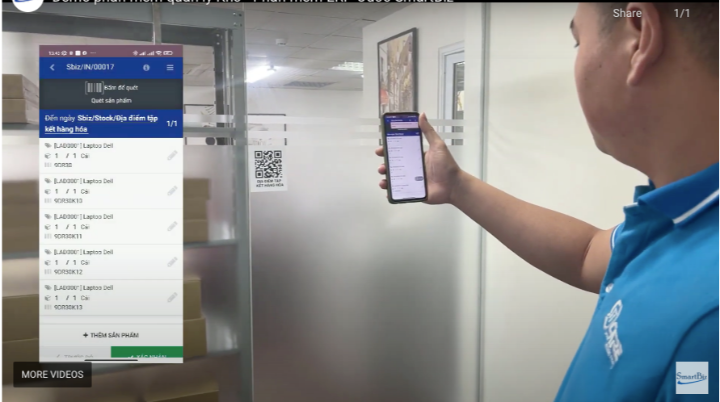
Optimal inventory management
2. Best practice: crawl, walk, run
During software selection, the vendor's job is to help customers “crawl, walk and then run”. Using a step-by-step approach, companies will not only build their inventory management on a solid foundation but also set up that system (and the company) for future success. See also current inventory management methods
In return, businesses gain full visibility of their inventory and the ability to make fast, accurate decisions about allocating orders and products.
To get started, assess where you are right now and where you want to go.
3. Assess your current state and future requirements
Finding the right inventory management system requires assessing the business's current needs and potential areas for improvement. And while predicting the future is never easy, assessing the current state, identifying any technology gaps and considering future plans can all help steer the business in the right direction.
Key questions to ask include:
What are we currently using, and how well does it work?
Bring in an outside consultant or software vendor to give a third-party opinion on the current inventory management solution and its capabilities.
What are the limitations of our current solutions?
What should be on the “wish list” if someone asked what an inventory management solution should handle? With today's cloud-based software systems, almost anything is possible.
What will you need one to five years from now?
Gather ideas from the sales and marketing teams, talk to your warehouse managers and run some customer focus groups to find where the new opportunities are. Taking advantage of them means optimizing your inventory management approach to meet your business's needs. This will give the business a clear picture of the company's current inventory management needs and what it will need over the years ahead and beyond.
4. Get the right product. Place it at the right time
Whether a company is a startup or ready to win more market share in its field, it will miss the mark without an automated, efficient warehouse management system.
In times of supply uncertainty and staffing constraints, companies can't do without accurate data or be held back by the number of people needed to manage all the manual inventory management processes.
By combining an inventory management system and a warehouse management system (WMS), organizations benefit from more accurate stock levels, automatic reminders for items that need counting, the ability to classify items by volume or value, improved quality assurance and higher customer satisfaction.
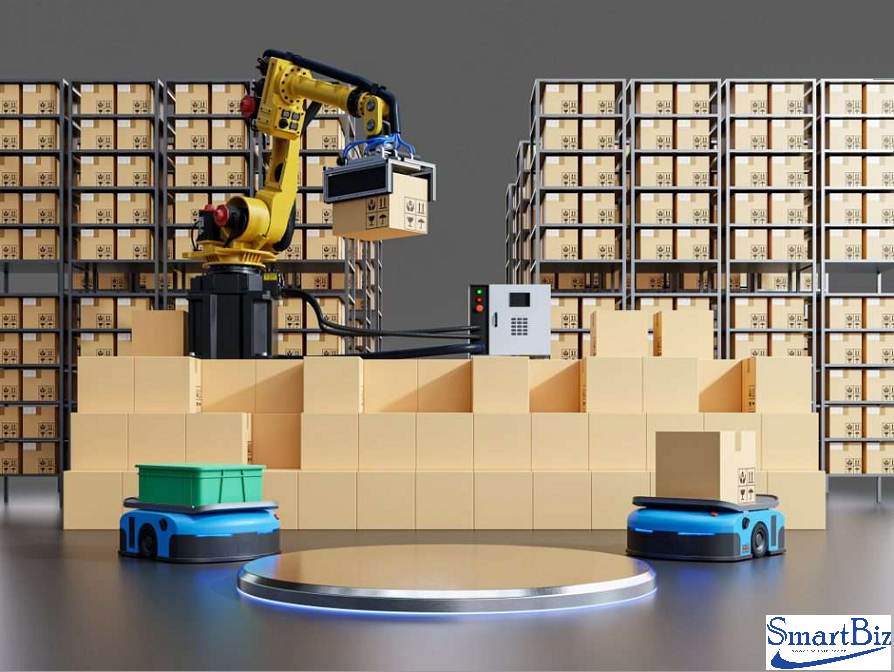
Smart warehouse
5. Additional tips for a smart warehouse system
Here are 19 feature considerations when choosing a smart warehouse management system:
STT | Feature | Description |
1 | Live sync | Central, live inventory figures are kept in one system and accurately reflected across all sales channels and warehouses in real time. |
2 | Forecasting | Past sales data can be used to forecast demand and plan for upcoming inventory requirements. |
3 | Reordering | Purchase orders can be created and managed so stock can be replenished quickly and easily. |
4 | Suppliers | All suppliers and vendors can be organized in one system and easily contacted when orders need to be created, changed or chased. |
5 | Barcode scanning | The system is compatible with barcode scanning to make tracking and identifying products easier. Learn more How to use online barcodes to look up goods quickly |
6 | Stock notifications | Notifications and alerts can be set up to show when a product has reached a predefined reorder point and needs replenishing. |
7 | Báo cáo | Provides in-depth data and analysis on sales, products and warehouses to make better inventory decisions in the future. |
8 | Returns processing | Return orders can be processed, with returned stock easily written off or added back into stock. |
9 | Multiple warehouses | Manage goods across multiple warehouses, stores and locations in one system. |
10 | Integrations | Connect the system to all the sales channels, POS systems, carriers, accounting software, etc. you need - and/or build the integrations you want through an open API. |
11 | Cycle counting | Assign weekly inventory counting tasks to your warehouse team so stock is kept continuously up to date with minimal discrepancies. |
12 | Automation and rules | Stock rules can be created to show different available quantities for individual sales channels and locations. |
13 | Bundles and product groups | Products can be grouped together to sell as kits and bundles while maintaining accurate central inventory figures. |
14 | Order management | Automatically import orders from all your sales channels so they can be easily viewed and edited in one central place. |
15 | Shipping & fulfilment | Integrate directly with carriers to view quotes, print labels and ship orders. |
16 | Pick & pack | Create and organize pick lists and packing tasks via paper printouts or digital scanners. |
17 | Warehouse management | Organize warehouse inventory, create automations and handle tasks such as putting away new stock, picking and packing, physical counts, etc. |
18 | Wholesale orders | Create and issue invoices, take orders by phone, process payments, and then actually fulfil and ship B2B orders. |
19 | Accounting | Within the system itself or by integrating directly with specific accounting tools to push sales and inventory data across the whole system. |
Measuring warehouse management effectiveness by inventory type.
Types of inventory stock held by companies include raw materials, work in progress (WIP), finished goods, packaging materials, and maintenance, repair and operations (MRO). Using the right inventory metrics can help you measure how successfully your company stocks and manages these inventory categories.
You can use inventory turnover as a measure of success for all these categories. However, there are additional metrics that are good practice for each type of inventory. The table below shows examples of which metrics are good practice for each category.
Inventory | Metric | Formula | Benchmark for the metric |
Raw materials | Inventory turnover | Cost of goods sold for the year / Average month-end raw materials inventory value | Top performers are at ~16.5 times per year. |
Work in progress (WIP) | Inventory turnover | Cost of goods sold / Average inventory used to produce goods | Compare this figure with previous years to assess performance. |
Finished goods | Order cycle time | Calculate the time from when a customer places an order until they receive the product. | Report this metric in days. Industry leaders achieve two to three days. |
Packaging materials | Packaging cost | Add up packaging, boxes, fillers and overall labor costs | This figure differs for every business, but each company should strive for continuous improvement. |
Maintenance, repair and operations | Inventory accuracy | Number of items listed as in stock / Total number of items found in the spare parts and materials store | ~95% |
Get ready and get started
Thanks to advanced technology, using a smart warehouse solution helps companies maximize profits while minimizing investment in inventory. This approach also helps businesses protect themselves from demand fluctuations, minimize risk, reduce losses, minimize administrative workload and avoid duplicate orders.
The SmartBiz smart warehouse management solution is ready to deliver a collection of inventory control and management features that overcome the biggest inventory management challenges. Track inventory across multiple locations, automatically manage reorder points, forecast demand and plan production and distribution. The system also includes features such as artificial intelligence (AI) and mobile device integration on the powerful ERP platform ranked 4th in the world. See it now: Smart warehouse management solution
Before you leave the page, let us know in the comments whether this content was useful to you.