This article covers everything a fast-growing business needs to know about inventory planning, from what it actually is to the best technology for the job. Get the expert tips of today's leading inventory consultants.
Effective inventory planning offers a fast route to reducing costs tied up in dead stock, an optimized product mix, happier customers, and higher revenue and profit. Learn about inventory planning models, which planning method suits your business, the benefits and how to develop a plan that delivers better results.
Let's get started!
Main contents
Inventory planning basics
What is inventory planning?
Inventory is material stored to serve current or upcoming demand. Production and manufacturing organizations hold raw materials, finished goods or work in progress to go into new goods. Retailers stock finished or processed items to sell directly to customers.
Almost every organization holds inventory. Even service organizations, such as hotels or software development companies, hold maintenance, repair and operations (MRO) inventory to support the business. Inventory often represents the largest share of a retail business's assets - up to 80% of cash is often tied up in inventory.
Inventory management planning is an integral part of a company's supply chain management strategy, along with order management, accounting, warehouse operations and customer management.
Inventory planning involves forecasting demand and deciding exactly how much inventory to hold and when to order. When done successfully, it helps companies meet demand while reducing spending.
The basics of good inventory planning
Inventory planning directly affects any organization's cash flow and profit. It prevents stockouts, so you can keep production running and save money on expensive last-minute purchases, and it enables discounts on bulk and regular orders. Good inventory planning requires the right combination of people, processes and technology.
Inventory planning technology:
You can use order-generation software to make sure you buy at the right levels and prevent overstocking. Digital planning systems provide historical data for forecasting and show current stock levels. The right software can help you scale your business.
Inventory planning roles and responsibilities:
Inventory planners analyze trends and make forecasts. Ideally, inventory planners work with supplier managers, contract management and purchasing leaders, supply chain financial analysts and stakeholders in production and quality control.
Inventory planning policies, processes and procedures:
Inventory policies help you manage planning activities and inventory maintenance processes step by step. It is essential that you define and document your inventory planning processes and communicate your policies throughout the organization and beyond, especially to the supply chain. Your procedures can range from how you use enterprise resource planning (ERP) and other warehouse software to how you store and pick items. Processes and inventory checklists can help you guide warehouse and distribution center staff in handling inventory.
Despite the advantages of inventory planning, many organizations don't do it. When companies don't plan, an inventory planner or consultant often comes in like a doctor in a health emergency to deal with excess inventory or shrinking profits.
“If you've reached the point where you want to do inventory planning, you definitely need to know there are a few variables. You need to know the lead times of your raw material suppliers. You need to know the uptime of your production plant, and it needs to be real time. Instead of assumptions, use real data. Break products down by category. Don't be afraid to tier your data and focus on the customers who pay your bills. Don't worry about the customer who only calls once every three years.”

Xem ngay Video: 📌How to plan purchasing & inventory accurately – avoiding the mistakes 90% of businesses make
The goals of inventory planning
The No. 1 goal of any business, besides making money, is customer satisfaction. In terms of inventory, without the right products in the best condition at the right time, customer loyalty can suffer. Customer loyalty affects profit because acquiring new customers costs more than retaining existing ones, and loyal customers stay longer over time.
Forecasting:
Also called inventory estimating, forecasting is a systematic process that uses the marketing plan to predict future sales and, therefore, future inventory requirements. Part of forecasting is inventory control, the process of counting and maintaining inventory items to understand usage patterns and maintain optimal stock levels.
Cost control:
Inventory costs, or holding and carrying costs, can add up to 20-30% of your business costs. Holding costs can include the cost of buying the items, taxes, labor to receive and put away inventory, insurance, security and even obsolete stock - that is, stock with no demand, old or surplus stock. The goal of inventory planning is to reduce all these costs.
Efficient storage:
With well-designed storage facilities and timely planning, you can positively affect profit. The end use of the inventory, whether for resale, production or fulfilment, affects the layout. The key is to arrange high-demand items to reduce travel time. In this case, high demand means frequently requested rather than high item quantities.
9 challenges in inventory planning
Inventory planning and demand planning pose many challenges, whether in retail or manufacturing. Besides the difficulty of predicting future requirements and sales, various obstacles can hinder forecasting.
In retail, the nature of the business sometimes obscures rational approaches to ordering. Patricia Johnson and Richard Outcalt are co-founders of The Retail Owners Institute®.
Outcalt says: “Retailers love to buy. They love new merchandise. Their staff are saying, 'We should carry this or that.' Everyone tells them, 'Oh, we have to have more stock.' Unless someone at the top has the discipline to manage to that targeted ending inventory and take markdowns quickly so they're sure to hit the target, they're in trouble. The pressure to buy is greater than the pressure to control. Someone has to be tough.”
In manufacturing, Whiteley says manufacturers often treat every product line the same, even when only one line is seasonal. Manufacturers also overproduce inventory because they think it's important to keep service levels consistent at all times.
He says: “That may be true if you're making heart valves for infants, but not all products are critical. The most important thing to know about inventory planning is to understand customer demand.”
Other factors can complicate the planning process itself:
1. Disorganized data:
You need historical stock levels and sales information, but this data often lives in multiple systems. You may have to go to accounting, fulfilment, logistics or point-of-sale (POS) systems to piece together a complete picture. If you have other responsibilities, this can take time.
2. No automation:
Software provides automatic tracking and reordering. People make mistakes, such as forgetting to place orders or miscounting stock in the warehouse.
3. Untrained staff:
On the other hand, software is only as good as the data users enter. Staff need to be properly trained on any system for the best results. Poor master data management also limits the usefulness of data and can lead to problems such as miscalculated lead times.
4. Perishable inventory:
Perishable inventory includes items with expiry dates that spoil over time, such as food and cosmetics, and some service items, such as restaurant tables or concert tickets. Perishable inventory requires a skillful effort to maintain service levels without ordering stock beyond demand that then spoils or expires.
5. Over-reliance on automation:
Technology alone can't do inventory planning. According to Outcalt, “there is an illusion that computers and POS systems are replacing proper training in inventory planning or attention to planning.
POS systems, like accounting systems, are historians. They show you to the penny what has happened. But how do you project forward? What is your profit plan for the year? What is your purchasing plan for the year? For many retailers, it's like driving down the highway at 65 miles an hour without headlights. Would you do that? No. But that's how they are driving their business. They need a plan so they can look ahead and see how to adjust.”
6. Multichannel inventory:
Organizations often pull inventory from multiple locations, such as brick-and-mortar stores, distribution centers or warehouses. Tracking diverse sources adds complexity to both inventory management and order fulfilment. Fulfilling orders from different locations increases shipping costs and frustrates customers who have to wait.
7. Poor picking processes:
With an inefficient warehouse layout, you lose productivity. Consider the distance items have to travel from the warehouse to the retail space or production floor. Place frequently requested items in areas where they can be picked quickly.
8. No cross-functional communication:
In some organizations, R&D, procurement, production and quality control don't talk about inventory requirements and potential problems until issues occur during production.
9. Planners leave:
Often, inventory planners learn your brand and work for a few seasons building knowledge of sales patterns, then they move on. New inventory planners may struggle to understand the warehouse's background and environment without accurate historical data or a sound system to capture it.
Read more The 19 costliest challenges in warehouse management
The role of the inventory planner
Inventory planners analyze demand and decide when and how much new inventory to order. Suppose you are the inventory planner for a hypermarket. Your working year might look like this:
Pre-season:
Before the season starts, the inventory planner analyzes SKU performance for previous seasons. The planner also needs key background data on competing brands, such as their promotions and prices. The planner then outlines a pre-season plan to set the category level or quantity of each product type to be sold.
In season:
Every week, the planner evaluates both product and category performance to determine whether sales are exceeding or falling behind targets. The results influence which underperforming products you remove from stock. This weekly review provides a picture of the business's health through the lens of inventory.
Business recap:
Planners must learn to read promotions, distribution issues, holiday promotions or weather events. Discount sales can deliver good profits, even though retailers often resist them. Planners can run analyses to reveal what kind of profit these discounts generate.
Markdowns and promotions
Markdowns can help you move more inventory when items aren't selling well. Promotions can help you attract unplanned purchases and move seasonal items. The inventory planner's job is to understand how to use these tools in the context of the business.
Reforecasting process:
The planner's week-by-week understanding of sales patterns and new trends informs repeated forecasts.
Evergreen or basic inventory: Basic inventory is easier to predict, and planners can often manage it separately from seasonal inventory.
Post-season:
Planners, buyers and merchandisers work together to review predicted and actual results for the season based on the financial and inventory experience.
How to develop an inventory plan
Another important consideration in inventory planning is always maintaining the best methods and processes. Proper inventory planning is a balance of human expertise (people), smart strategy (processes) and the right tools for the job (technology). Consider these questions when developing your inventory strategy.
What is the product volume?
Demand forecasting is possible. For retail, use keyword research to inform Google Trends searches. Your inventory planning software should also show historical trends, or you can try Google Analytics to understand e-commerce activity trends. Based on this research, schedule orders to stock up when you predict high demand. Include items for off-peak sales.
What factors affect inventory?
Factors that affect demand include well-considered advertising, competitors' sales and offers, the income and circumstances of the target market, seasonal demand, and customer trends and preferences.
Is the warehouse efficient?
In a well-organized storage space, staff can easily put away new stock and quickly pick items for fulfilment. The space should be large enough to hold extra stock when suppliers offer deals, but not so large that you pay rent and electricity for unused space. A warehouse's location can bring economic advantages; a warehouse close to suppliers can reduce shipping costs and let you get materials before competitors. Third-party logistics (3PL) companies can manage warehousing and fulfilment for you.
Is the ordering process streamlined?
Look for ways to improve the connection between inventory management and orders.
See also A guide to warehouse management processes that eliminate 95% of waste
What can you automate?
POS systems and other functions reduce errors in detailed, repetitive tasks and free staff to focus on improving planning and processes.
Inventory planning models
Inventory planning and control systems won't be the same for every business. Good practices in inventory planning and control can help you keep lean inventory, but finding the right level can be a problem.
The models meet the needs of the types of goods a company handles - mainly those dealing in:
Raw materials
Partially finished goods
Finished goods
The most popular inventory models today
1. The deterministic inventory model
The deterministic inventory model is most commonly used by raw materials traders. Deterministic models use a preventive approach to avoid stockouts. One example is the Economic Order Quantity (EOQ) model.
EOQ formula

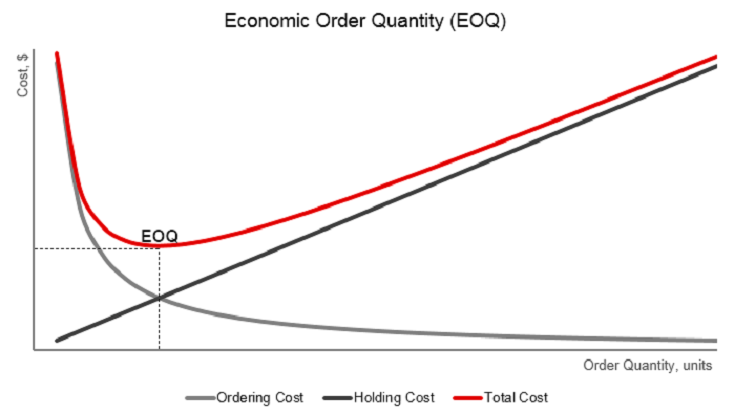
The EOQ model
For example, with food inventory planning software, the EOQ model can be used to calculate the optimal order quantity to reduce inventory costs and maximize value. It is an effective model as long as demand stays relatively stable. But it doesn't account for seasonal changes or external fluctuations. Deterministic models therefore require constant monitoring to succeed.
2. The work in progress (WIP) model
This model best suits those trading partially finished goods, finished goods or goods in transit (GIT). This inventory model focuses on holding inventory and has three motives for doing so.
The transaction motive holds that buying raw materials in bulk is cheaper and lowers the cost per unit. The precautionary motive uses inventory as a safeguard against demand uncertainty to prevent stockouts. The speculative model encourages holding inventory to mitigate increases in material and/or labor prices.
3. The perpetual inventory model
The perpetual (or continuous) inventory model is also commonly used by companies trading partially finished or finished goods. Continuous systems constantly monitor quantities, and replenishment orders are placed as soon as stock falls below the set threshold (the reorder point).
This is the only system that cannot be maintained manually. The perpetual model relies on specialized technology. But it lets sellers track current stock and avoid stockouts.
See also Is Amazon's supply chain model worth adopting for Vietnamese businesses?
4. The Just-in-Time (JIT) inventory model
The just-in-time (or JIT) inventory model works by aligning orders for materials or items from suppliers directly with the production schedule. In other words, the company keeps just enough inventory to meet market demand.
Learn about how to apply the JIT model in warehouse management
The idea is to increase efficiency and reduce waste by ordering and receiving goods only when needed and never in excess. So to succeed with this model, retailers must forecast demand as accurately as possible.
The idea is to increase efficiency and reduce waste by ordering and receiving goods only when needed and never in excess. So to succeed with this model, retailers must forecast demand as accurately as possible.
Lean inventory tips
To manage inventory well, you need to apply continuous research and analysis. Here are the steps to optimize inventory:
· Review inventory periodically and revise your inventory model as new trends emerge. The stocking method must fit each item, as not every item has the same demand or delivery schedule.
· Your inventory plan must address your unique situation. Only a detailed analysis of each item and its turnover rate can reveal the nature of your inventory.
· Practice category management. In other words, understand the patterns for each type of item. Category management can be especially important for diverse, rich inventories. Outcalt explains:
In retail, there are very few precious things that are controllable, and one very controllable thing is inventory. “Professional planners, usually small businesses, are very sharp at controlling their inventory. They plan to the penny what their inventory will be at the end of each month, and if it climbs, they deal with it immediately. Unfortunately, larger retailers - say with 50 or 100 or 500 stores - no longer follow that discipline.”
· You can't manage inventory in a silo without input from upstream and downstream functional areas. Stakeholders from each functional area must understand each other's requirements. As you learn about problems from team members, record possible improvements and collect data. Also consider self-assessing the effectiveness of your current systems or using a third-party benchmarking service. Use this information to create a vision for an improved method, and then share it.

The inventory management process
Data and craft in inventory planning
No one can perfectly predict inventory six months to a year in the future. Getting close requires real-time inventory data and communication across operations, finance, sales and marketing. You need not only the right data but also the ability to interpret it. Conversely, you also need to understand the nuances of your brand or product and its context within the larger commerce ecosystem. Your understanding of influences and trends will help guide decisions on markdowns and promotions.
Material requirements planning
Material requirements planning (MRP) is used in production planning and inventory control to keep stock levels optimally low while ensuring a regular supply of resources and quality output. Organizations used to carry out MRP manually on paper.
Today, companies track inventory in software. MRP involves three basic steps:
· Determine your current stock, any standing orders, products scheduled for delivery and stock already committed to existing orders. Inputs to this first step include customer demand forecasts, the bill of materials (BOM) for a product line and the master production schedule.
· Calculate additional requirements for inventory you consider critical, expedited or delayed.
· Order the necessary components. The calculation produces four types of documents: purchase orders to suppliers; work orders and material plans for your production department; primary reports, including information from orders; and secondary reports, including statistical information on orders and production.
MRP uses two main inputs: the master production schedule and the bill of materials (BOM). A master production schedule describes weekly staffing requirements, required inventory and the expected output rates of the products being delivered. It is the high-level guide for management, purchasing and production, from which leadership creates short-term schedules and allocates resources. A BOM is a complete list of all the raw materials, parts and sub-assemblies needed for a finished product. Organizations can use BOMs internally, or affiliated manufacturing companies can share them with each other. The BOM is an essential input to an MRP system.
Inventory control
While inventory planning looks to the future to predict demand, inventory control handles the processes of receiving, unpacking, verifying, storing and releasing inventory. Companies use inventory control to set up stocking systems, including reorder points and reorder quantities.
Some facilities use ABC analysis to classify stock based on consumption value, which is the total value of an item over a given period. A items have the highest consumption value and C items the lowest. This analysis focuses on the important items in stock.
To manage inventory well, you need to apply continuous research and analysis. Here are the steps to optimize inventory:
· Review inventory periodically and revise your inventory model as new trends emerge. The stocking method must fit each item, as not every item has the same demand or delivery schedule.
· Your inventory plan must address your unique situation. Only a detailed analysis of each item and its turnover rate can reveal the nature of your inventory.
· Practice category management. In other words, understand the patterns for each type of item. Category management can be especially important for diverse, rich inventories. Outcalt explains:
In retail, there are very few precious things that are controllable, and one very controllable thing is inventory. “Professional planners, usually small businesses, are very sharp at controlling their inventory. They plan to the penny what their inventory will be at the end of each month, and if it climbs, they deal with it immediately. Unfortunately, larger retailers - say with 50 or 100 or 500 stores - no longer follow that discipline.”
· You can't manage inventory in a silo without input from upstream and downstream functional areas. Stakeholders from each functional area must understand each other's requirements. As you learn about problems from team members, record possible improvements and collect data. Also consider self-assessing the effectiveness of your current systems or using a third-party benchmarking service. Use this information to create a vision for an improved method, and then share it.
The inventory management process
Data and craft in inventory planning
No one can perfectly predict inventory six months to a year in the future. Getting close requires real-time inventory data and communication across operations, finance, sales and marketing. You need not only the right data but also the ability to interpret it. Conversely, you also need to understand the nuances of your brand or product and its context within the larger commerce ecosystem. Your understanding of influences and trends will help guide decisions on markdowns and promotions.
Material requirements planning
Material requirements planning (MRP) is used in production planning and inventory control to keep stock levels optimally low while ensuring a regular supply of resources and quality output. Organizations used to carry out MRP manually on paper.
Today, companies track inventory in software. MRP involves three basic steps:
· Determine your current stock, any standing orders, products scheduled for delivery and stock already committed to existing orders. Inputs to this first step include customer demand forecasts, the bill of materials (BOM) for a product line and the master production schedule.
· Calculate additional requirements for inventory you consider critical, expedited or delayed.
· Order the necessary components. The calculation produces four types of documents: purchase orders to suppliers; work orders and material plans for your production department; primary reports, including information from orders; and secondary reports, including statistical information on orders and production.
MRP uses two main inputs: the master production schedule and the bill of materials (BOM). A master production schedule describes weekly staffing requirements, required inventory and the expected output rates of the products being delivered. It is the high-level guide for management, purchasing and production, from which leadership creates short-term schedules and allocates resources. A BOM is a complete list of all the raw materials, parts and sub-assemblies needed for a finished product. Organizations can use BOMs internally, or affiliated manufacturing companies can share them with each other. The BOM is an essential input to an MRP system.
Inventory control
While inventory planning looks to the future to predict demand, inventory control handles the processes of receiving, unpacking, verifying, storing and releasing inventory. Companies use inventory control to set up stocking systems, including reorder points and reorder quantities.
Some facilities use ABC analysis to classify stock based on consumption value, which is the total value of an item over a given period. A items have the highest consumption value and C items the lowest. This analysis focuses on the important items in stock.
Inventory planning KPIs
Metrics and KPIs can help you and stakeholders across the organization evaluate how successful your inventory planning people and processes are. Consider implementing KPIs such as these and others that may suit your business:
Inventory turnover
Cost of goods sold
Customer satisfaction level
Daily sales or inventory movement
Forecast accuracy
System accuracy, to determine how accurately your system reflects physical inventory
Storage capacity used
Percentage of orders delayed due to stockouts
Inventory planning systems
ERP inventory control systems improve visibility, control and analysis across all settings, from factories to warehouses, including mobile facilities. Notably, materials management (MM) modules coordinate orders with procurement and other modules.
Although ERP systems include location management for inventory, they usually don't include a separate warehouse management system (WMS), which focuses less on inventory and more on warehouse operations.

Warehouse management systems
The advent of barcodes and scanners meant printed labels appeared on goods. Operators with handheld scanners automatically record each activity with greater efficiency and accuracy. With the expansion of radio frequency ID (RFID) tags across the supply chain, even greater visibility and accuracy can be achieved.
For more detailed tips on building a warehouse system, read more How 5,000+ businesses successfully build smart warehouse systems
Get ready and get started
Good inventory planning brings many advantages. At a high level, understanding what you have today supports forecasting the future.
The SmartBiz smart warehouse management solution is ready to deliver a collection of inventory control and management features that overcome the biggest inventory management challenges. Track inventory across multiple locations, automatically manage reorder points, forecast demand and plan production and distribution. The system also includes features such as artificial intelligence (AI) and mobile device integration on the powerful ERP platform ranked 4th in the world. Learn more: Smart warehouse management solution
Before you leave the page, let us know in the comments whether this content was useful to you.